Showing posts with label Farm Bill. Show all posts

December 30, 2014

2014's top 20 key events affecting agriculture

Share:
The last few days of the year are always a good time to reflect on the past year and prepare for what is ahead in the upcoming. Many people are in high-spirits coming off of the Christmas holiday (or maybe just a sugar-high!) and it gets us excited to know what the next year will bring.

Looking back on year 2014, there are many highlights, extremes and moments that will go down as a big year with shifting winds for U.S. agriculture. Changing economics for both crop and livestock producers, a new farm bill and policy shifts, and the growth of big data are a few to mention.

Brent Gloy, a well-known ag economist formerly with Purdue University who became a full-time Nebraska farmer this year, provided his list to AgWeb of 20 key events impacting agriculture in 2014.

Farmers Begin the Year Flush. Producers in early 2014 were still riding a wave of very high profits, with the financial condition of the U.S. farm sector the strongest in decades. Farmland values stood values stood at all-time highs in almost every region.

Lower Incomes in 2014. USDA called for a 25% decline in net farm income. Reports began suggesting that the great farm boom was over and times were rapidly changing. While some talked of a bubble that might burst and the income hit was notable, others noted that the farm sector remained in relatively good condition.

Farmland Values and Cash Rents Stop Rising. This year may be recalled as the year that land values and cash rents stopped shooting higher. While USDA and some other surveys reported that prices were going up, other surveys observed that prices were flat to lower. The confusion was due to the timing of the surveys and values/rents being measured. Overall, it appears values did peak and began to head lower. Some are saying a major correction could be in the works.

EPA Delays RFS Decision. Ethanol demand mandated by the renewable fuel standard (RFS) has been a big driver of the great agricultural boom. The RFS has come under repeated scrutiny since its implementation, but the EPA’s late 2013 decision to reconsider aspects of the RFS was big news in 2014. After initially proposing to reduce the amount of ethanol blended into gasoline, the EPA postponed its decision until 2015. Many analysts are suggesting that big changes in the RFS are now unlikely. Keep watch in 2015 as big changes would be a surprise to the market.

Ethanol Profits Climb. With lower corn prices and strong domestic and export demand, 2014 was a great year for ethanol producers, but the crash in oil prices raises questions for 2015.

Ideal Weather, Great Crops. Near perfect growing conditions led to speculation that the U.S. was on the verge of a record corn crop. While the actual totals were a bit lower than mid-season estimates, the crop was substantial. Stockpiles of most row crops are now comfortable and indeed large, but the U.S. is not quite to the point of being ridiculously oversupplied.

California Drought. As California felt the grip of a powerful drought, the impacts have been staggering, with some estimates pointing to losses in excess of $2 billion. Even today, 99% of California remains in drought and 55% in the most severe category.

The El Nino That Never Came. In early June, forecasts called for an El Nino to occur, with 70% estimates for summer arrival, 80% by fall. But El Nino never came. Today, the forecast places odds at 65%.

Crop Price Free Fall. From June 30 to October 1, the December 2014 corn contract lost $1.23 per bushel, pushing prices below the cost of production for most farmers.

Transport and Basis Issues Hammer Northern Plains and Corn Belt. No question but that the development of shale oil resources in the Northern Plains contributed to transportation challenges, but the amount of grain production also has grown substantially in recent years. Corn plantings in this region will be under pressure in 2015.

Concern Over Margin Squeeze. The cost/price squeeze won’t likely be alleviated until fixed costs, such as land prices, cash rents, equipment costs, labor costs, family living expenses adjust, prices rebound, or some combination of these.

Early 2015 Budgets Show Big Losses. In late fall, universities started putting out 2015 crop budgets and the numbers weren’t pretty. Many showed budgeted losses of $100 per acre

Surprise Rally Buoys Spirits. A big surprise caught many off-guard while the biggest corn crop in history was being harvested: Corn markets rallied 54 cents per bushel from October to December. Keep a close eye on the crop insurance price discovery period for clues about next year.

Livestock Profits Surge. While row crop incomes were under pressure in 2014, the livestock sector experienced outstanding levels of profitability, and the outlook for 2015 is bright.

Porcine Epidemic Diarrhea Virus. PEDv rocked the hog and pork markets. PEDv left the industry with fewer hogs to market, thus driving up prices and producers worrying about their herd health and financial losses. A second wave of cases is likely this winter.

Machinery Dealers Start to Feel the Pain. As commodity prices fell, many believed equipment would be one of the first purchases farmers would cut back on. Recent data suggests that combines have experienced the softest sales, with November sales off more than 50% from a year ago.

Ag Manufacturers Cut Jobs. John Deere led the scale-back in August, announcing a cut in its workforce, mainly from the agricultural equipment division. Syngenta announced in late November that it was reducing its global workforce as well.

Farm Bill Passes, and Farmers Are Still Scratching their Heads. The new farm bill offers more complicated choices for farmers than any bill in recent memory. ARC-Individual, ARC-County and PLC will be the subject of many discussions and meetings this winter. Even prices used to determine payments under the various programs, or the Market Year Average prices aren’t as simple as they initially seem.

Interest Rates Stay Low. Farmers have benefitted from low interest rates and they stayed very low in 2014. While many have been arguing that rates can’t go much lower, 2015 may be the year that changes that, given recent signals from the Federal Reserve Board.

GMOs on the Ballot. While measures to require labeling of foods containing GMOs failed to pass in Oregon and Colorado this fall, a ban on growing GMO crops passed in one Hawaii county. Attention and focus on GMOs has been growing.

Gloy also mentions other noteworthy issues in 2014, which include: Ebola causes U.S. scare; big data and big ambition; China’s ban on corn and DDG imports over GMOs; the Russia-Ukraine conflict and embargo; and the crash in oil prices.

February 12, 2014

A new Farm Bill…finally.

Share:

The agriculture industry has been waiting for years. Literally. For the day a new Farm Bill – or the Agriculture Act of 2014, is signed into law. 

After several years of deliberations, multiple extensions, and countless hours of work, President Obama is signed the Agriculture Act of 2014 at Senate Ag Chair Debbie Stabenow’s alma mater, Michigan State University.

According to Brownfield news, Chairman Lucas says this has been a long time coming.  “I’ve told my committee members I feel much better now that it’s passed the House, it’s passed the Senate, and the President has signaled he’ll sign it,” he says.  “When you consider how much effort it took to get here and when you consider how difficult this process has been, I’m not sure I will sleep with both eyes closed until the dry ink copy of the bill gets to the National Archives for filing.”

Ahead of the bill’s signing, President Obama said the Agriculture Act of 2014 is a sign that Republicans and Democrats can come together in Washington and work together. “With this bill we break the cycle of short-sided, crisis driven partisan decision-making and actually get this stuff done,” he says.  “It’s a good sign.  And that’s the way you should expect Washington to work.”

Farm Bill. Jobs Bill. Conservation Bill. Food Bill.

Despite its name, the President reminds us the Farm Bill doesn’t just help farmers. “Secretary Vilsack calls it a jobs bill,” he says.  “An innovation bill.  An infrastructure bill.  A research bill. A conservation bill. It’s like a Swiss Army Knife.”

Now that the Farm Bill has been signed, it’s up to the United States Department of Agriculture (USDA) to implement the programs.

To do that, Agriculture Secretary Vilsack says teams for each Farm Bill title have been put in place.

“We’ve asked those teams to identify the rules, regulations and guidelines that have to be adopted because of new or different modifications to existing programs,” said Vilsack.

The Secretary says another group will be responsible for prioritizing what needs to be done first.

“For example, it’s fairly obvious to me that we have to have the disaster assistance for livestock operators restored as quickly as possible because these folks have been waiting for a couple of years,” the Secretary said. “There’s a new dairy program, there’s obviously a revenue protection program, there are slight changes to crop insurance, and those things are obviously priorities.”

Listen to the audio interview with Vilsack from Brownfield, here.

November 22, 2013

3 Things Every Nebraskan Should Know About the Farm Bill

Share:
Without a Farm Bill, it’s difficult for Nebraska farmers and ranchers to plan for their business. And since agriculture is Nebraska’s largest industry, this Congressional inaction has a direct effect on our state’s economic success.

The Farm Bill is vast and complicated. But here are three things you should know:

1 About 80 percent of the Farm Bill’s cost is for nutrition programs, primarily the Supplemental Nutrition     Assistance Program (SNAP)—which was commonly known as “food stamps.” (Maybe it should be called the “Food Bill”?)

2 The Farm Bill includes funding for foreign market development and market access programs that enable groups such as the U.S. Meat Export Federation and U.S. Grains Council to do their jobs in building global demand for U.S. red meat and grain.

3 Crop insurance is a cost-share arrangement, with the federal government paying a portion of the insurance premium and the farmer paying another portion. Without government backing, it’s unlikely that any insurance company would offer the coverage—and the nation’s food and commodity supply would be at risk. Additionally, the payments are made to crop insurance companies, n
ot to farmers.

September 24, 2013

Will We Finally Have a Farm Bill? By: Casey Campbell

Share:
The Farm Bill will finally be going to conference now! Can y’all believe it? Despite all the work I did over the summer and all the nights I prayed for a new Farm Bill to pass, I still can’t. Don’t get me wrong, I’m still waking up in the night panicking that somehow all of our effort will be wasted and we’ll end up back with the 2008 bill again, but I’m a heck of a lot more hopeful now. Since the House passed their SNAP half of the Farm Bill my hopes are up, but the clock is still desperately ticking.

We can definitely expect some heat with the Senate’s $4 billion cuts over 10 years versus the House’s $4 billion cuts annually. With not a single Democrat vote for the House’s SNAP Bill Thursday, it will be impossible to pass without lots of compromise. On the positive side, at least the SNAP programs will finally be put back in the Farm Bill like they belong after the House wasted all our time splitting it.

September 30 is coming fast though and House Majority Leader Cantor still hasn’t even named the House members who will be part of the conference with the Senate. Maybe he hasn’t looked at a calendar to see how soon the 2008 bill is expiring, but just cancelling their planned recess for this week is not going to cut it. The Democrats and Republicans, urban districts and rural districts all need to work together. This bill is important for every single American and too much has gone into the bill to just extend the 2008 one again.

August 30, 2013

Kernels of Truth Podcast: the Farm Bill is important to everyone

Share:
The Nebraska Corn Board is starting a new series of podcasts called Kernels of Truth, featuring Nebraska Corn Board members, Nebraska corn farmers and cooperators of the checkoff programs.

In this podcast, Tim Scheer, chairman of the Nebraska Corn Board, shares the importance of the Farm Bill to our ag economy and our consumers. Also, Tim stresses how Congress needs to hear from farmers about a new, five-year Farm Bill.

Click here to listen to the podcast.

Congress needs to hear from farmers! Find the countdown on the Corn Board's homepage, then connect with key policymakers to urge them that it is time to set aside political partisanship and do the right thing—pass a Farm Bill now.

Kernels of Truth podcasts are also available on iTunes! Click here to subscribe.

August 20, 2013

Podcast: Urging Nebraska Leaders to Make Progress with the Farm Bill and RFS

Share:
In this podcast, Curtis Rohrich of Wood River and member of the the Nebraska Corn Growers Association, urges farmers to take action on the Farm Bill. There is a lot happening on the state and national level right now that will have a dramatic impact on your freedom to farm—and on your profitability. It's important that corn farmers be engaged in the policy process—especially in the next few weeks.

Congress is in its August recess, which means that Nebraska's Congressional delegation will be back here in the state—where you can talk with them face to face. Obviously, getting a new Farm Bill passed is paramount.

When Congress gets back in September, they will have nine days to get it done—or we'll automatically revert to previous farm policy, some of it dating back to the late 1940s. Crop insurance as well as funding for trade promotion and research are all uncertain at this point—and as you know, it's tough for any of us to make decisions about our operations when we don't know what's going to happen on the federal level.

Listen for more!

Nebraska Corn Kernel podcasts are also available on iTunes! Click here to subscribe.

August 17, 2013

Kernels of Truth Podcast: Farm Bill Now!

Share:
The Nebraska Corn Board is starting a new series of podcasts this month called Kernels of Truth, featuring Nebraska Corn Board members, Nebraska corn farmers and cooperators of the checkoff programs.

In the first podcast, Don Hutchens, executive director of the Nebraska Corn Board shares about how Nebraska corn farmers need to urge Congress for a Farm Bill Now. Congress is on recess right now, but when they come back in September, will only have 9 days to act on a new, five-year Farm Bill.

Click here to listen to the podcast.

Congress needs to hear from farmers! Find the countdown on the Corn Board's homepage, then connect with key policymakers to urge them that it is time to set aside political partisanship and do the right thing—pass a Farm Bill now.

Kernels of Truth podcasts are also available on iTunes! Click here to subscribe.

August 7, 2013

Congressional Countdown for the Farm Bill

Share:

image32 days, 12 hours, 57 minutes, 05 seconds….04, 03, 02, 01, 00.

The countdown is ticking on the Nebraska Corn homepage to show Nebraska farmers the time left that Congress has to take action on a new, five-year farm bill.

Once they are back in session, the House will have only nine working days until the current Farm Bill extension expires.

This lack of Congressional action on a Farm Bill could stifle the economic vitality that Nebraska agriculture has brought to the state over the past several years.

According to Tim Scheer of St. Paul, chairman of the Nebraska Corn Board, “All the progress achieved and contributions that agriculture has made in the past decade are at risk if Congress continues to drag its feet,” he said. “We need Nebraska farmers to speak up now and get our nation’s leaders to cooperate on a Farm Bill. Congressional leadership stated they were not hearing from farmers last fall, so we need to get our voices heard this year.”

The current Farm Bill, crafted in 2008 and extended last year, is set to expire September 30, 2013. If a new bill or an extension of the 2008 bill is not passed, federal price supports revert to their 1949 levels. If that happens, some farmers, such as those involved in wheat or dairy production, would be big winners—while others, such as soybean farmers, would get nothing at all because some commodities were added after the 1949 legislation.

“Nebraska farmers should not settle for another extension of the 2008 bill. We need a new Farm Bill that is in step with what is happening today and with the future challenges and opportunities for agriculture—and we need it now,” Scheer said. “Without Congressional action, America’s farm policy will become a patchwork of policy that is unworkable for producers trying to run their businesses and plan for the future.”

Read the full news release.

The Nebraska Corn Board has established a page on its website that enables farmers to reach Nebraska and key federal policymakers via email to make comment.

  • When communicating with our Nebraska delegation, be sure to thank them for their support for a new Farm Bill—and urge them to put pressure on their leadership to pass a new Farm Bill.
  • American agriculture needs a Farm Bill that is in step with today’s economy and an increasingly competitive global marketplace.
  • America’s farmers and ranchers need a long-term Farm Bill in order to plan, operate their businesses and provide a reliable, abundant food supply.
  • We need to ensure sustained food security and food assistance for our nation. A piecemeal approach is simply not acceptable.
  • Simply extending the current Farm Bill—or worse yet, reverting back to decades-old legislation—is not an acceptable alternative.
  • Agriculture has been a bright spot in our nation’s economy—improving our trade balance, creating jobs and revitalizing rural communities across the nation.
  • We need the assurance of crop insurance, trade promotion, and exports to provide stability, demand and growth.
  • Ag research is critical to maintaining America’s global leadership in food production.
  • It is time to set aside political partisanship and do the right thing—pass a Farm Bill now.


CONTACT KEY POLICY MAKERS

Click on name to contact via email.

Nebraska Representatives:

National Representatives:

July 30, 2013

Leadership trip to D.C. first for Nebraska Corn delegation

Share:

leadership tour corn congress 2013Each summer, corn grower leaders and staff from state and national corn associations gather in Washington D.C. for a series of action team and committee meetings, visits with their respective state’s Congressional delegation and the semi-annual National Corn Growers Association’s Corn Congress.

The Nebraska Corn Board sponsored eight individuals that have been involved in the Nebraska FFA, 4-H or LEAD program to join these corn grower leaders to attend Corn Congress. This opportunity was invaluable to introduce the leadership group to policy development through the National Corn Growers Association, understand current issues (Farm Bill, immigration, RFS, etc), hear from leaders within various Federal Agencies, engage with policy leaders through Hill visits, and network with industry leaders to allow for growth in leadership development and agricultural policy knowledge.

Don Hutchens, executive director of the Nebraska Corn Board who accompanied the leadership group said it was encouraging to witness their enthusiasm and participation.

“They were not shy in asking our Nebraska delegation questions on the Farm Bill, Renewable Fuels Standard, Immigration and Trade,” said Hutchens. “They were also joined by three of the national interns sponsored by the Corn Board.  The Corn Board is sponsoring internships with the D.C. office of NCGA, and the St. Louis office.  Also an intern at the USGC office. They had the opportunity to hear Sec. Vilsack of USDA, briefed on trade issues by Darci Vetter the Acting Under Sec. of Farm and Foreign Ag Service (a native Nebraskan), and Jim Bair of the North American Millers Association.”leadership tour corn congress 2013 (2)

Natasha Hongsermeier, a delegate on the leadership tour described the trip as a wonderful experience. “I am truly a more knowledgeable and a more informed ag youth because of all of the experiences offer by our trip to Washington, D.C.”

Another delegate on the tour, Morgan Zumpfe, said, “This experience was awesome for me because it combined three of my favorite things: meeting new people, trying new things, and promoting agriculture. You can research the Farm Bill and polity as much as you want, but it isn’t quite real until you get to see it happen in real life.”

June 25, 2013

Podcast: Farm Bill Discussion

Share:
In this podcast, Curt Friesen, District 3 Director and Vice Chair on the Nebraska Corn Board, and farmer from Henderson, NE, urges pertinent information about the Agriculture Reform, Food and Jobs Act—otherwise known as the 2013 Farm Bill.

Curt first thanked Senators Johanns and Fisher for their support of the bill out of the U.S. Senate. The Senate bill would reduce overall spending by $24 billion over ten years, compared to about $38 billion in the House version. Much of the savings would come from the consolidation of conservation programs, reductions in the food stamp program and cuts to farm subsidies.

The Senate and House versions of the legislation mirror each other in terms of the area of reductions, but it's the scope and depth of those reductions that are expected to be the subject of debate.

Listen for more!

Nebraska Corn Kernel podcasts are also available on iTunes! Click here to subscribe.

June 17, 2013

Exciting times to be an intern in Washington, D.C.!

Share:
Kyle McGinnBy Kyle McGinn, NCGA-DC Intern 

Greetings! My name is Kyle McGinn, and this is my first blog entry. I am a native Nebraskan and a student at the University of Nebraska College of Law. With the gracious support of the Nebraska Corn Board, I have the pleasure of serving as the summer intern in the Washington D.C. office of the National Corn Growers Association. The NCGA D.C. office is a tight-knit team, who supplement the efforts of the NCGA Headquarters Office in St. Louis, Missouri, to protect corn producers.

I have been fortunate to join the office during an exciting period. Both houses of the U.S. Congress are presently working towards the passage of a new Farm Bill. Indeed, the U.S. Senate just passed their version of the Farm Bill earlier this week, and the House should begin consideration of their version shortly. The NCGA staff has worked vigorously, to ensure that the new Farm Bill reflects the best interests of our nation’s 400,000 corn farms, and the 23,000 Nebraska corn producers.

A major component of the work of the NCGA D.C. office is monitoring legislation and hearings which may have an effect on corn production. To this regard, I have had the pleasure of accompanying NCGA staff to several Congressional hearings over the course of the past few weeks, including a hearing of the House of Representatives Committee on Oversight and Government Reform Subcommittee on Energy Policy, Health Care and Entitlements Hearing regarding bio-fuels, and examining the Environmental Protection Agency’s Role in implementing the Renewable Fuel Standard (RFS), a hearing of the House Natural Resources Committee regarding the implementation of the Endangered Species Act, and a hearing of the House Foreign Affairs Committee regarding international food aid. I also had the distinct pleasure of accompanying the NCGA staff to a luncheon keynoted by the Secretary of Agriculture, Tom Vilsack of Iowa. Mr. Vilsack spoke of the importance of responding to climate change, and the resulting pressures on agricultural producers. He introduced new USDA led efforts to combat the negative effects of climate change, including new regional research hubs. Additionally, USDA is working to reduce food waste, which piles up at landfills and emits heat-trapping methane gas. Vilsack also said USDA is focusing on new land conservation efforts and encouraging farmers to make renewable energy and energy efficiency upgrades.

Lastly, I have also been assisting the staff by researching various topics, including Farm Bill Amendments, free trade agreements (including the Trans Pacific Partnership and the Transatlantic Trade and Investment Partnership, and the use of GMOs on National Wildlife Refuges, amongst other issues.

The NCGA D.C. Office is located nearby busy Union Station, which is a transportation hub in Washington. Commuters and travelers alike use Union Station to access the Metro (the local subway), trains, and busses. I myself have used Union Station frequently to navigate the city. Just a few days ago, the NCGA and other partners of the Corn Farmers Coalition began an impressive advertising campaign in Union Station, highlighting the achievements of U.S. corn producers in boosting yield while simultaneously decreasing inputs and promoting sustainable practices. Union Station is one of two Metro stations used most frequently by Congressional members, staff, and other policymakers. Several friends and colleagues have remarked to me on the posters, so they have certainly captured the attention of local travelers and residents. I encourage you to review the pictures of the advertising campaign, which are featured in a June 6, 2013 post on this blog.

On a personal note, I have greatly enjoyed my few short weeks in Washington. Last week, I had the pleasure of attending a Washington Nationals baseball game, versus the local rival the Baltimore Orioles. I have also had the pleasure of bicycling to visit the various monuments, and playing softball on the National Mall. Thanks for reading, and my sincere thanks to the Nebraska Corn Board for your support.

May 16, 2013

Farm Bill….now?

Share:
kelly brunkhorstBy Kelly Brunkhorst, director of research

Déjà vu…but let’s hope that this time we have a different ending.

Tuesday, the Senate Agriculture Committee marked up and passed their version of a 2013 Farm Bill. The bill will now head to the full Senate for debate that is expected to happen in the next couple of weeks.

Like the National Corn Growers Association on their statement following passage, we are pleased to see action being taken on a new Farm Bill. Although it will be a long process, a critical first step has been accomplished and awaits full Senate action, while in the House Agriculture Committee, they working on their version of a new 5-year Farm Bill.

Providing farmers with certainty was one of our key points this past year as we pressed hard for a Farm Bill Now. You can catch past blogs here, here and here. Ultimately we were disappointed when the full House did not take action on a Farm Bill, even though it had passed the House Agriculture Committee and we settled on a last minute extension of the current Farm Bill.

Additionally, just as import as domestic demand is international demand and providing certainty, yet again, for our cooperators such as the U.S Grains Council and U.S. Meat Export Federation who utilize Foreign Market Development and Market Access Program funds was critical. Both FMD and MAP funding are part of the Farm Bill.

So as the House Agriculture Committee works through advancing their version of the Farm Bill, our hope is that will happen swiftly and then action can be taken on both bills in their respective Senate and House chambers. Then eventually through conference to work out differences in a bipartisan fashion…an action that we hope will be different than last year.

UPDATE:  Late into the evening on Wednesday, the House Agriculture Committee approved their version of new Farm Bill.  Our expectations are the full Senate will take action next week followed by the House in the early part of June.  

And through the entire process, your voice is important! Call your Representative and Senators and ask them to support a new five year Farm Bill that will provide you certainty on your operation.

April 17, 2013

Podcast: NCGA President's address at Commodity Classic

Share:
In this podcast, Dan Nerud of Dorchester and member of the Nebraska Corn Growers Association, shared about the messages from the  presidents of the commodity membership associations for corn, soybeans, sorghum and wheat who were interviewed on stage during the 2013 Commodity Classic General Session. This year, Pam Johnson was featured. Pam is the president of the National Corn Growers Association and a family farmer from Iowa. Pam's primary message had to do with the need for America's farmers to be more vocal about sharing our story as farmers.

Pam did not mince words when it came to expressing her concern and frustration over the gridlock in Congress over not getting a farm bill passed. The National Corn Growers Association is 36,000 members strong. That's why president Pam Johnson challenged all of us to step up and leverage those numbers to make things happen on Capitol Hill.

Listen for more!

Nebraska Corn Kernel podcasts are also available on iTunes! Click here to subscribe.

March 18, 2013

Celebrating the role of agriculture

Share:

*Special post by Senator Mike Johanns

Johanns, Mike-011409-18419- 0007Each morning, while the rest of the world is still fast asleep, ag producers across Nebraska are up, checking on their herds or preparing their equipment for a long day in the fields.  Careers in farming or ranching offer few days off.  Cattle still need to be fed on Christmas morning. Crops, ripe for harvest, don’t care about your vacation plans. A break from the fields on a rainy day is an opportunity to get caught up on equipment maintenance. And animals don’t need veterinarians only between 9 and 5.

For 365 days a year, farmers toil with the earth and tend to their livestock to provide food and fiber for the rest of the world, but how often do we consider how the produce gets to the supermarket? One day in particular is devoted to raising this awareness.

agdayMarch 19 marks the 40th National Ag Day, a time to celebrate the hard work by America’s ag producers to provide safe, abundant and affordable food supplies, and an opportunity to reflect on how the products we depend on every day reach store shelves.

In Nebraska, where nearly 47,000 farms and ranches form a patchwork across the state, we are well versed in the chain of events that must occur before food can reach the table, but in many places across the country, where farmland gives way to pavement, this important work can easily be taken for granted. National Ag Day offers a chance for all Americans to learn about the important role agriculture plays in our country, not just in feeding and fueling the world, but also by providing jobs at home and strengthening relationships abroad.

Agriculture dominates Nebraska’s economy.  The state leads the nation in red meat production at more than 7 billion pounds a year. It also produces more popcorn and Great Northern beans than any other state, and ranks fourth in total land mass used for ag production. That’s a lot of livestock and cropland to maintain. But all that hard work can pay off. Nebraska’s agriculture receipts total more than $21 billion a year—a huge part of the state’s economy. And our state’s $6.9 billion in ag exports generates $9.3 billion in economic activity at home.  A third of all jobs in Nebraska are tied to agriculture, and the state enjoys one of the lowest unemployment rates in the country: 3.8 percent, compared with 7.7 percent nationally.

The benefits of American agriculture go far beyond our borders. We produce more food than we consume and we continue to foster trade opportunities that help feed the world while strengthening our economy. At home, places like the University of Nebraska are researching new ag techniques to help farmers grow more food on less land using fewer resources to continue feeding a growing global population.

Many ag organizations will be descending upon Washington to help tell the story of the important role agriculture plays in our country’s prosperity. It couldn’t come at a better time, as lawmakers continue to craft a new fiscally-responsible, reform-minded farm bill that focuses on needed risk management tools, and better reflects the state of the ag industry. Ag producers work hard year round to provide necessities to our nation. We all benefit from the fruits of their labor.  It’s time Washington returns the favor by passing a responsible five-year farm bill.

IMG_2070

November 30, 2012

Staff Update

Share:
In this week's staff update Don Hutchens talks about some of the effects we've seen so far from not getting a Farm Bill passed.


September 10, 2012

Nebraska ag groups push for a Farm Bill Now

Share:
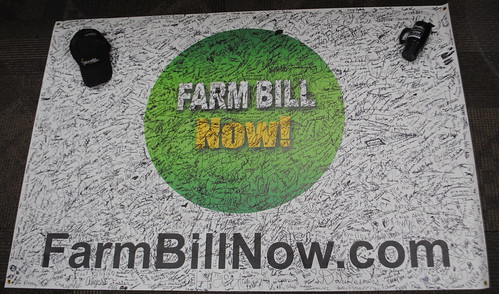
Farm Bill Now banner with signatures of support.

Nebraska agriculture organizations, initiated by the Nebraska Corn Board and Nebraska Corn Growers Association, have come together to put pressure on the U.S. House of Representatives and Congress to pass a Farm Bill – and now.

At the Nebraska State Fair, the corn checkoff board and growers organization came together to educate and advocate for showing support for a 2012 Farm Bill. Fair goers had the opportunity to sign their name on a large banner, as well as take handout cards with contact information for Nebraska’s federal representatives and the House Ag Committee.

“This year has given us plenty of uncertainty due to a drought that has plagued the nation and the implications can be seen across many facets of agriculture,” said Tim Scheer, farmer from St. Paul and Nebraska Corn Board chairman. “But as a farmer, one certainty that I am asking for is a Farm Bill. Whether you are a food producer or food consumer, you should be asking for the same.”

Scheer said that efforts at State Fair and the upcoming Husker Harvest Days are to educate those about the Farm Bill and ask them to take action by signing the Farm Bill Now banner, calling their congressional representatives and signing the petition on FarmBillNow.com. They can also easily Tweet their representatives with the #farmbillnow hashtag and write a message on their Facebook page.

The current Farm Bill is set to expire this year. Collectively Congress has yet to pass a Farm Bill, although a version has been passed by the Senate. A version has yet to be passed by the House.

“Time is running out for action on the Farm Bill,” said Carl Sousek, president of the Nebraska Corn Growers Association. “Congress will only be in session a few days in September and then the “lame duck session” following the November elections. I ask that you visit with your Senator or Congressman, thank them for their past work and ask them to press for passage of a Farm Bill.”

In addition to efforts at State Fair and Husker Harvest Days, a joint letter of support from over a dozen agricultural organizations in the state has been signed that encourages legislators to pass a Farm Bill that reauthorizes disaster assistance, streamlines conservation programs, provides sound risk management programs, and continues the priorities in foreign market development.

For you to take action, please join these ag organizations at the Ag Commodities Building (booth #8) during Husker Harvest Days, September 11-13 to sign the banner and go to www.farmbillnow.com.

September 4, 2012

NCB Staff Update with Kelly Brunkhorst

Share:
In this week's staff update Kelly Brunkhorst talks about why we need a farm bill now! For more information visit the Nebraska Corn Board website or www.farmbillnow.com .


August 29, 2012

Farm Bill Now!

Share:
FarmBillNowWith the importance of raising public awareness of the need for Congress to pass a new, comprehensive, five-year farm bill before current farm programs expire in September, a coalition of 39 of the nation’s foremost agricultural organizations have come together and created Farm Bill Now.

Why do we need a Farm Bill? Here is what the group says, on the importance of new farm legislation for America’s farmers:
“Calling the farm bill the ‘farm bill’ suggests its impact is limited only to farms and to the rural areas to which they are so closely tied. It’s really a jobs bill. A food bill. A conservation bill. A research bill. An energy bill. A trade bill. In other words, it’s a bill that affects every American.

“The farm bill affects our nation’s ability to provide the necessities of life for a global population projected to pass 9 billion by 2050. Here at home, it affects an industry that provides 23 million—or 1 in every 12—American jobs.
“The farm bill has broad impact on our citizens and our economy. It provides healthy foods to millions of schoolchildren and nutritious options to families in need. It develops and expands trade with valuable foreign markets. By reducing spending significantly compared to prior farm bills, the proposals pending right now in Congress address the need to get our nation’s fiscal house in order.
“And yes, it benefits American farms—98 percent of which are owned and operated by families. It helps big farms and small farms, major crops and specialty crops, organic farmers and conventional farmers, cattle ranchers and cotton ginners, farmers markets and national suppliers, and the vast range of other pursuits that make up American agriculture. This year, it would help farmers tackle the challenges posed by the worst drought in a generation.
“While Congress waits to finish the farm bill, we are united in asking all Americans to encourage legislators—home for summer town hall meetings and  speeches—to finish this vital legislation before the current farm and food law expires in September. After all, it’s your bill too.”
What can you do? Farm Bill Now launched an interactive web portal – www.FarmBillNow.com where you can connect to your members of Congress and show your support for a new five-year farm bill. You can sign a petition of support and directly tweet messages to Congress while connecting to others tweeting using the hashtag, #farmbillnow.
image

July 17, 2012

Washington Adventure - Part 2

Share:
By David Bresel, NCGA-DC Intern
I have been in Washington D.C. for approximately six and a half weeks and I am still loving it out here.  The important policy decisions that I’ve had a chance to work on and the people I’ve had the opportunity to meet have made this an amazing experience that I’ll not soon forget.  One of the major policy issues that the office and I have been working on is the Farm Bill. 

The Farm Bill was successfully passed in the Senate.  Now we are working our hardest to get the Farm Bill through the House of Representatives.  It is easy to tell that the House Farm Bill is not the most ideal version that NCGA would have preferred.  But having a farm bill pass before the 2008 farm bill expires is important to every agriculture organization.  So, for the last week everyone in the office has been hard at work motivating our Representatives to do something to pass this vital piece of legislation.  My duties have ranged from interpreting the bill language and amendments to going on Capitol Hill visits with the lobbyists. 

Another office project that I have been working on is getting ready for Corn Congress.  Working with the lobbyists I have been helping them get their presentations and agendas ready for the event.  I’ve even had a chance to write a few memos that were used during Corn Congress.  Sitting in on meetings at the event has really given me a greater appreciations for the members of NCGA. 

I was also lucky enough to go to Crab Fest at Chip Bowling’s farm. Chip is a corn grower in Newburg, Md.,  and serves as a member of the National Corn Board.  It was the first time that I’ve ever eaten crab like that.  I also had a chance to go on a boat ride in the Chesapeake.  It was overall a great day and a fantastic experience and I’d like to publicly thank Chip for hosting that event. 

One more noteworthy event that I had the opportunity to witness was seeing the Supreme Court hand down the decision on the health care reform act.  Jon Doggett and Natalie Cook told me to go to the Supreme Court to see the events that were taking place outside as it was going to be a historic day.  So I went to the court and I somehow found my way inside the building.  Then I was able to get into the chamber of the Supreme Court where I sat next to Michelle Bachman and saw the nine justices on the bench and listened to Justice Roberts read the majority opinion in the decision.  No matter what my opinion is on the decision given by the Court it was still an incredibly humbling experience to be sitting there watching and listening to the justices.  It is an experience that I will remember for as long as I live. 

I am so happy to be working at NCGA.  It has reaffirmed my belief that working in the agriculture industry is what I want to do for my lifelong career.    I can honestly say that being here at NCGA and working with the Nebraska CornBoard has been one of the best experiences of my life.  

The National Corn Growers Association office in Washington, D.C. is hosting David Bresel of Lincoln, Neb., as their summer intern supported by a partnership between Nebraska Corn Board and NCGA. David is a student in at the University of Nebraska College of Law. He will be involved with a variety of issues related to environmental regulations, transportation, free trade agreements, biotechnology, ethanol and energy.

June 19, 2012

Washington Adventure

Share:
By David Bresel, NCGA-DC Intern

David BreselMoving to Washington D.C. for the summer was a dream come true. I have always wanted to spend time in our nation’s capital and was so glad to have the opportunity to do so. Through some friends of friends I was very lucky and found a place to live near Dupont Circle within the city. The neighborhood I live in is great with lots of young professionals and many places to see and visit. It is relatively close to work being right near a Metro train stop. I just hop onto the train everyday and it’s fast, easy and convenient.

My first day at work was great. I didn’t start until the afternoon which allowed me the chance to walk around the neighborhood where the National Corn Growers Association offices are. I gladly discovered what is now one of my favorite things about this city so far, FOOD TRUCKS! Food trucks are a wonderful idea where local restaurants and startup eateries serve a different assortment of goods from their trucks. There is anything from lasagna trucks to cheesecake trucks. It is wonderful to try different foods all the time with the convenience of being located right across the street from the NCGA office location.

I’ve always believed the thing that makes a job great is the people you work with. The people at NCGA are incredible. I have really enjoyed these past two weeks getting to know them, shadowing them, and working with them. My duties have been mixed with administrative type work and legislative policy work. This is great because it has given me the opportunity to really see and get to know all aspects of the NCGA office.

One of the biggest things that the office and I have been working on is the Farm Bill that is being debated in the Senate currently. NCGA and everyone in the agriculture community in D.C. is working hard to try and get the Farm Bill passed. Working to see the bill move through the Senate and then onto the House I’m certain will be an incredibly rewarding experience. It’s been a great opportunity to see how lobbying and politics work on a federal level.

Every day that I come into the office I have been extremely excited. It’s a wonderful feeling to go to work looking forward to what the day has in store. I am eager for the next coming weeks with all of the challenges and rewards that are in store for me and the staff at NCGA. Working here at NCGA has opened an entire new world of career opportunities and desires for my future. I’m very happy to say that things in Washington D.C. are great.

The National Corn Growers Association office in Washington, D.C. is hosting David Bresel of Lincoln, Neb., as their summer intern supported by a partnership between Nebraska Corn Board and NCGA. David is a student in at the University of Nebraska College of Law. He will be involved with a variety of issues related to environmental regulations, transportation, free trade agreements, biotechnology, ethanol and energy.