Showing posts with label food safety. Show all posts

February 1, 2016

Animal Advocacy: Articulating Your Story

Share:
Today’s livestock producers take what they do very seriously. The legacy and knowledge of raising animals merits a great pride in farmers and ranchers. They are deeply rooted in their values whether that be in their community, the environment or raising a calf crop each year. With the rearing of animals for meat comes the charge to compassionately care for that animal, become accountable for how they provide for their livestock and positively promote what and why they do what they do.

Animal Welfare


Much of the pride that livestock producers have from raising animals comes from responsibility. Today more than ever, cattle ranchers, pork producers, dairy farmers and poultry producers take the responsibility of raising healthy cattle for high-quality, nutritious beef very genuinely. Much of that responsibility is stewardship which leads to following animal welfare guidelines.

Much of the way livestock and poultry are handled is traditionally passed down from generation to generation on family operations, or comes from personal experience and training. Yet, as industry standards change, producers also want to change to make sure they are doing the best to take care of their animals. Practices of production such as de-horning, castration, use of vaccines and antibiotics, etc., all have their purpose in the industry, but the way they are handled can be skewed by the public eye.

Accountability


Farmers and ranchers must be responsible for the way they handle their animals. One form of accountability for beef producers is the Beef Quality Assurance (BQA) program, a national program that provides guidelines for beef cattle production. This is not new to the industry; cattlemen and women have been practicing stewardship and proper handling for years.

The cattle industry formalized its first quality program in the late 1970s when it was called the “Beef Safety Assurance” program, designed to help cattle farmers and ranchers ensure their production practices were safe and met consumer expectations. The BQA program, the first of its kind in the world, soon followed and was officially established in 1987.

BQA raises consumer confidence through offering proper management techniques and a commitment to quality within every segment of the beef industry. Cattlemen and women have embraced BQA because it is the right thing to do. It is an educating program that has evolved to include best practices around good record keeping and protecting herd health. The pork industry offers similar programs, including Pork Quality Assurance Plus (PQA Plus) and Transport Quality Assurance (TQA), to support animal well-being and maintain a safe, high-quality supply of pork. Their “We Care” initiative ties everything together to help the public view the pork industry as a self-regulated business that earns the trust of others.

The poultry and dairy industries provide similar quality assurance programs, as well.

Advocacy


Along with programs like BQA and PQA Plus, cattle producers are encouraged to practice advocacy techniques while they are in the public eye. Unfortunately, those that do not understand agriculture have misguided ideas and sometimes share erroneous information, pictures and video about the treatment of food animals. In our country, rural communities have declined and consumers are generally two or more generations removed from having meaningful ties with the people and places where their food is raised. Without those ties to agriculture, consumers don’t know about modern food production. And some might not care. Until a video or picture comes across their Facebook news feed and suddenly they are brought into a social license dilemma.

Social media has drastically changed how agriculture is viewed and how people talk about their food. While it has brought negative views and questions to livestock production, the two-way street allows livestock producers to have a voice as well as a listening audience that is focused on where they intersect and can relate with one another. And that intersection is something we all enjoy: food.

When consumers are concerned about how their food is raised, it gives producers an opportunity to talk about their animal welfare and is a good wake-up call to all livestock producers that others are watching. This is especially true at livestock shows. There is a critical eye watching every move and producers need to be ready to share their story with emphasis on why and how.


Articulate Your Story


Are you prepared to answer critical questions on production practices that come naturally to you? Why do you use clippers on your animal? What are you feeding them? Where do you keep your animals? These questions might be something you’ve never thought about. Our industry needs to take time to stand in our consumers’ shoes and have a good working knowledge of the industry, as well as use terminology that most people will understand.

It’s an especially good reminder to be proactive. Help consumers connect the dots by reaching out to them and asking if they have any questions.

January 25, 2016

The Amount of Pesticides Farmers Use is Not a "Latte"

Share:
Sometimes the word "pesticide" can be kind of scary and we don't really know what that means for the crops grown right here in Nebraska.

The reality is that the amount of weed killer that a farmer would use in an acre (about the size of a football field) is about the size of a latte.  That's really "not a latte"! Find out what else North Dakota farmer and CommonGround volunteer Sarah Wilson, can surprise you with about pesticide use on the farm in this video.


Since farming and food go hand in hand, enjoy this recipe from one of our favorites, The Pioneer Woman.


Skillet Lasagna

2 tbsp olive oil
1 1/2 lbs ground beef
2 garlic cloves, minced
1 jar, 24-oz marinara sauce
1 tbsp Italian seasoning
Kosher salt and black pepper to taste
1/2 cup sour cream, at room temperature
1/2 cup grated fresh mozzerella
12 oz cooked bow-tie pasta (farfalle), cooked to al dente
8 basil leaves, chopped (or about 2 tbsp dried basil)

Directions
Heat olive oil in a large skillet over medium-high heat. Cook the beef with garlic until completely browned; drain fat.
Pour in the marinara sauce.
Add Italian seasoning and S&P to taste.
Stir, reduce the heat to low and simmer for 15 minutes.
Add the sour cream and stir until combined.
Add mozzarella and cooked pasta; stir until well combined.
Serve hot with chopped basil on top.

CommonGround is a national movement of farm women who want to share information about farming and the food we grow. Consumers in the cities and suburbs are more disconnected from farm life than ever before, and that disconnect has led to misconceptions about modern farming and the people behind it. We’re a group of Nebraska farm women working to help dispel myths and built trust in farm families again. We want to answer questions and share facts as well as our personal stories of farm life. Please join us in finding our CommonGround.

October 26, 2015

Subway’s decision to give in to food-fear marketing

Share:
Last week, Subway restaurants announced that they would be sourcing meat that has never been given an antibiotic starting in 2016. The announcement brought with it a fiery social media battle of farmers and ranchers trying to post their opinions and comments on the Subway Facebook page, with Subway deleting comments and upsetting people even more.

The decision was frustrating for those of us who raise livestock for meat and know what we really do to raise healthy food. Fear marketing is more and more present in our retail food chains and this is evident with Subway’s decision. Did they do their research? Did they talk to farmers and ranchers? Enough people in agriculture took action and reached out to Subway about their policy that Subway came back with this revised statement:

"That said, we recognize that antibiotics are critical tools for keeping animals healthy and that they should be used responsibly to preserve their effectiveness in veterinary and human medicine. Our policy is that antibiotics can be used to treat, control and prevent disease, but not for growth promotion of farm animals. Accordingly, we are asking our suppliers to do the following:
  • Adopt, implement and comply with the U.S. Food and Drug Administration’s (“FDA’s”) guidance for industry 209 and 213, which requires that medically important antibiotics not be used for growth promotion. Visit the FDA site to learn more. Assure that all antibiotics use is overseen, pre-approved and authorized by a licensed veterinarian before they are administered to any animal.
  • Keep accurate and complete records to track use of all antibiotics.
  • Adhere at all times to all legal requirements governing antibiotic withdrawal times. This assures that antibiotics have been eliminated from the animals’ systems at the time of slaughter.
  • Actively encourage, support and participate in research efforts focused on improving animal health while reducing antibiotics use."
Subway's response shows a definite influcence by the agriculture community and it is exciting that our voices were hear. Yet, it seems that they are being influenced by people who do not have an understanding of why antibiotics are being used in animal agriculture. If they had talked to a farmer and rancher about raising meat before all of this came out in public, here is what they would have found out:

Livestock must be healthy and well-cared for in order to produce great, quality meat. And just one of the ways that farmers and rancher keep their animals healthy is by using antibiotics.

We don't just use antibiotics to use them. On farms and ranches, they have a herd health program where the livestock get regular medical care, including checkups, that starts with vaccinations to prevent disease (much like a well-child checkup for kids). But sometimes animals get sick, just like we do and it’s necessary to treat them. So we give antibiotics if an animal is injured or to fight a bacterial infection. This is the most common and prevalent use of antibiotics in livestock.

Under the care of our veterinarian, we closely follow the label and dosing instructions which are approved by the FDA.


The FDA regulates the approval and use of antibiotics in animal medicine. Their approval process is stringent and they use the same testing for antibiotics in animals as they do for humans. Any antibiotic given to a food animal has a specified withdrawal time which is the amount of time from the last shot until it is out of their system. An example could be that we notice signs of respiratory disease in one of our cattle, we work closely with our veterinarian and under the guidelines of the FDA to give that animal an antibiotic where we follow the label and dosing instructions. The maximum length is 28 days and we will never sell that animal to go into the food system until that 28 days is up – so the FDA assures us that is no antibiotic residue in our meat as well as the USDA randomly inspects meat to make sure it is safe.

We work with our veterinarian; it is a law that we follow this withdrawal time. When the withdrawl time is up – the antibiotics have left the animal’s system. This means that the animal is ANTIBIOTIC-FREE, which equals = ALL MEAT IS ANTIBIOTIC-FREE BY LAW!

And we take that very seriously, which means doing the right thing by closely monitoring the care we give our animals. We want to continue to earn the respect and trust we have with our meat buyers and meat eaters and we want healthy animals to provide healthy, safe and nutritious beef.

Farm and ranch families depend on healthy cattle for our livelihoods. We care for our livestock by giving them a good diet, good medical care and healthy living conditions. Our commitment to providing top-notch meat begins with top-notch animal care.

Unfortunately, Subway is not the first – nor the last – to give in to fear marketing and change the food they are providing based on the consumer’s opinion. Let's continue to band together and share with others how animals are treated and raised. Also, send them to CommonGround volunteers who can help assure consumers that they don't have to have fear in their food! Visit FindOurCommonGround.com.

May 12, 2015

Chipotle’s Bold Move to GMO Free…But Will it Last?

Share:

clip_image002Two weeks ago, Chipotle took its propaganda filled marketing campaign to a troubling new level when it announced that its entire menu will be GMO-free—meaning nothing served at its fast-food restaurant chains will contain ingredients derived from genetically modified plants or animals. According to their website, the company is “G-M-Over It” and has decided that serving GMO’s in their restaurants does not align with their vision of “food with integrity.”

Even though Chipotle’s GMO stance opposes the best scientific knowledge in the world, the company has taken a bold stance that GMO’s are unsafe and have long-term implications that consumers should be concerned about. But what scientific evidence supports these claims? According to a 2014 report by the World Resources Institute, GMO-derived foods have been widely consumed for years and “there is no evidence that GM crops have actually harmed human health.”

The bottom line…this GMO-free campaign has satisfied some of Chipotle’s most loyal and health-conscious guacamole fans, however, it has missed a huge opportunity to ethically educate American’s about where their food comes from.

So was Chipotle’s declaration to be “G-M-Over It” a good choice? Will this marketing hype last? Will consumers actually fall for their unethical propaganda? In a recent article on NPR, writer Dan Charles entertains “why we can’t take chipotle’s GMO announcement all that seriously” with five rational points that every consumer should be aware of. We highlighted a few below…

1. Soda

At the bottom of the page that announces Chipotle’s new policy, you’ll find the following statement: "Many of the beverages sold in our restaurants contain genetically modified ingredients, including those containing corn syrup, which is almost always made from GMO corn."

Looks like the fast-food giant is making quite the exception to its GMO-free policy when it comes to sugary drinks.

2. The "superweed" double standard

image

As an example of the ways that GMOs can damage the environment, Chipotle points to the problems caused by herbicide-tolerant GMO crops and how they encourage farmers to use a single herbicide, usually glyphosate, or Roundup. This, in turn, has led to the emergence of herbicide-resistant weeds, which Chipotle calls "superweeds." Chipotle's answer to this, per its new non-GMO policy, is to switch from soybean oil to sunflower oil.

The problem is, many sunflower varieties, while not genetically modified, also are herbicide-tolerant. They were bred to tolerate a class of herbicides called ALS inhibitors. And since farmers starting relying on those herbicides, many weeds have evolved resistance to them. In fact, many more weeds have become resistant to ALS inhibitors than to glyphosate.

Why should Chipotle bemoan the emergence of weeds that are resistant to glyphosate, yet not to other weedkillers?

3. Meat

Chipotle says it wasn't too difficult or expensive to remove GMO ingredients from its burritos. It simply had to find new suppliers for corn flour and cooking oil.

It would be much harder, and presumably more expensive, to use only meat from pigs or chickens that consumed a non-GMO diet. That's because the amount of corn or soybeans required to feed Chipotle's animals is vastly larger than what's needed for its tortillas or cooking oil. Finding a new supply of animal feed would raise costs, so Chipotle isn't doing it.

To view the full NPR article, click here.

April 30, 2015

The "Food Babe": Bullying her way out of food credibility

Share:
Raise your hand if you've heard of the "Food Babe".

For those that haven't, she's a mommy/food/nutrition blogger who feels it's her role in life to scare people about what food they are putting in their mouth. She aims to use fear tactics to sell her books, promote her diet plans and force companies to stop using federally inspected and approved products that help our food to be safer. But what she doesn't reveal is that she isn’t even a nutritionist. Nor is she a toxicologist or a medical doctor. Yet she doles out nutrition, toxicological, and medical advice with the confidence of someone trained in all three areas.

And people believe her because she "sounds" smart, she's got good looks and social media-manipulating skills.

Of course she is teaming up with other anti-modern farming supporters like Chipotle and Dr. Oz, and campaigning against GMOs in our food. And many companies have bowed to her pressure of "consumer demand" - which is really only one person. The fad-dieters loved her and all jumped on her bandwagon. But is her minute of fame over?

Now there are many - consumers included - who are back lashing against her saying that her promotions are not based in facts/science and are simply to scare people to make more money.

There have even been some anti-Food Babe'rs who have come up with their own satirical accounts of Food Babe like Chow Babe and SciBabe. They easily point out how the Food Babe is making money scaring the living daylights out of food consumers, while simultaneously bullying companies that use ingredients that are FDA approved safe for consumption.

The BEEF Daily blog recently came out with a list of 10 negative review of the "Food Babe" worth reading & sharing. Worth reading indeed.

While time and time again, we learn that emotions are what convince people about food and agricultural topics. Yet it is exciting that science is taking its role to prove the facts against someone who is manipulating emotions to extreme and nonfactual realities.

The real message that consumers - and that means all of us because we all love consuming food - is that we need to do the research on our own about what type of food we eat and feed our families.

And talk to a farmer. We know some good ones who can tell you the basis of how food is grown.

January 15, 2015

Are GMO’s A-OK?

Share:

Food has become a hot topic in the media and around the dinner table. The production and politics of food are on the minds of policy makers, special interests groups and consumers in general. One of the most talked-about subjects is the advanced science used to produce new plants and organisms through the manipulation of genetic material. Today we will look at genetically modified organisms—GMOs—and provide answers to many of the questions you may have about them.

image

1.) What is a GMO?

When creating a GMO or genetically modified organism, researchers copy specific genetic information from one plant or organism and introduce it into another to improve or enhance a specific characteristic or trait, such as resistance to insects. Developing special traits in plants allows for more food to be grown in more places using fewer chemicals and fewer natural resources

2.) What’s the difference between GMOs and biotechnology?

While the two terms are frequently used interchangeably, biotechnology more closely refers to the process or technology used to create GMOs. You may also see the term “GM”, which of course means “genetically modified.” When you hear farmers talk about “biotech” hybrids or varieties, they are talking about the GM seeds they plant.

3.) What is a Bt crop?

These are crops genetically engineered to carry a gene from the soil bacterium Bacillus thuringiensis (Bt). This bacterium produces proteins toxic to certain pests—caterpillars, mosquitoes and corn rootworm–but do not affect humans and other mammals. The crops that contain the Bt gene can produce the toxin, thus shielding themselves from targeted pests— and reducing the need for pesticides.

4.) Is genetic modification a new thing?

Manipulating genes in plants is an approach that has been used for centuries to make bread, cheese, wine and beer. Today, nearly every food on grocery store shelves has been modified by human hands at the genetic level. The foods we eat are modified using various breeding methods. Breeding alters a plant’s genes so that it expresses new traits. That’s how we get those desirable family favorites such as, seedless watermelons and grapes, red grapefruit, peanuts, honey crisp apples and other foods. GMOs and biotechnology simply accelerate this process. “Everything about science is learning new ways to speed up evolution so that we can come up with crops faster than Mother Nature ordinarily would,” said Dr. Sally Mackenzie, Ralph and Alice Raikes Professor of Plant Science at the University of Nebraska–Lincoln. “Genetically modified is a part of our future. If we want to eat with climate change, we will need technologies or we simply won’t survive, and that’s just a reality.”

5.) Are GMOs safe for humans?

To date, more than 2,000 peer-reviewed studies have confirmed that GMOs are safe for human consumption. While there have been a handful of studies that state otherwise, these studies have been roundly debunked by scientists around the world. With over 25 years of independent research, there is no documented evidence of harm to human health or deaths from consumption of GM foods. (National Research Council, European Commission)

6.) Are there GMO-free foods?

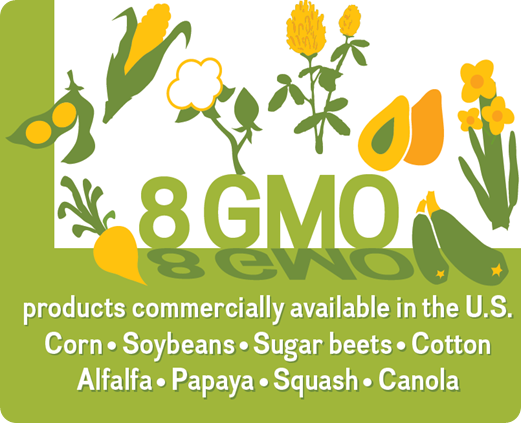
Genetically modified wheat is not grown in the United States. Genetically modified corn, soybeans and other commodities are approved for production in the U.S. As a result, trace amounts of GM products are found in many processed foods in the form of corn, soybean or canola oils—even when those foods may be labeled “GMO-free.”

7.) Is it safe to eat meat and milk from animals that were fed GMO crops?

Absolutely. A 2012 review of 24 long-term or multigenerational studies found that genetically modified corn, soy, potato, and rice had no ill effects on the rats, cows, mice, quails, chickens, pigs and sheep that ate them. Growth, development, blood, tissue structure, urine chemistry and organ and body weights were normal.

8.) How does genetic modification affect nutrition?

There is no difference. Exhaustive testing and FDA review has confirmed that GMOs are nutritionally the same as their non-GM counterparts. They have the same levels of key nutrients such as amino acids, proteins, fiber, minerals and vitamins.

9.) Do GMOs cause allergies?

No. GMOs do not create new allergens that are not already present due to other unrelated factors. If a person is allergic to a non-GMO plant, they will be allergic to the GMO variety since the two are nutritionally the same.

10.) Do GMOs cause gluten intolerance?

There is absolutely no relationship because there is no GMO wheat on the market today. If such a product were to come on the market, it could not cause new allergies because standard GM testing and FDA review ensure that GMOs are not introducing new potential allergens

GMO products

August 7, 2014

VIDEO: Kernels of Truth–GMO Safety

Share:

Are GMOs really safe for humans and the environment?

The answer is not just yes, but in some cases, more so than non-GMOs. Let’s take a closer look.

There have been over 1,700 reputable studies on GMO safety by organizations like the American Medical Association, the World Health Organization, and the food regulatory bodies of numerous governments, including the United States and the European Union.

Every one of these studies has shown GMO foods to be just as safe as non-GMOs. The only time a study ever showed a difference in safety, it actually found the GMO to be safer. This is not surprising, considering they go through years of testing by the FDA, USDA, and EPA before being sold, in order to assure they’re absolutely safe for human consumption and our environment.

Watch our short video to learn more about GMO safety.

If you missed the first video, What are GMOs?, watch it now!

February 25, 2014

Attack of the Killer Tomatoes: A GMO story

Share:
Dr. David Holding, Assistant Professor Plant Molecular Genetics, Research in his laboratory focuses on understanding endosperm hardening during maturation and its relationship to protein quality in maize. 2010 photo for Center for Plant Science Innovation shoot. Photo by Craig Chandler / University CommunicationsBefore genetic modification, the alkaloid levels in that tomato on your BLT could have killed you. And instead of corn on the cob, you’d be eating a handful of birdseed.

Genetic management and selective breeding have been used for centuries (Gregor Mendel and Luther Burbank, anyone?). Today, we’re just doing it better.

As farmers and ranchers work to meet the daunting challenge of feeding an exploding global population, they continue to grow more with less – less water, less land, less fertilizer and pesticides, and less impact on the environment.

Currently, genetically modified (GM) crops—also referred to as “biotechnology”—are an important part of a farmer’s portfolio. But they are not an end-all solution.

“The research we do is not an either-or proposition; it’s a continuum,” said Dr. Sally A. Mackenzie, the Ralph and Alice Raikes Professor in the department of agronomy and horticulture in biological sciences at the University of Nebraska—Lincoln. “We’re not able to predict what biotechnology will give us. It’s a tool in an increasingly robust toolbox.”


Genetic modification

Dr. Mackenzie says that genetic modification simply refers to human intervention to create a different genetic combination to create a desired outcome.

“We’re using transgenes to create gene combinations that result in diversity and enhanced performance. The outcomes rely on the genes themselves and how they are expressed within the plants.” This same concept is being used in animal research and in human health research for cancer and other diseases
.
Researchers are focused on helping plants overcome stresses, challenges and inhibitors that keep them from achieving their full genetic potential. Epigenetics is one emerging technology that involves temporarily adding a transgene to a plant and then removing it—while leaving the effects of that transgene intact within the plant. This can lead to more vigorous plants, more biomass and more production.

“With epigenetics, what you eat is not transgenic, but transgene technologies were used to affect the performance of the plant,” Dr. Mackenzie said.

“There has not been a single documented case of a food allergy or human health situation due to crop biotechnology.”

Researchers are also looking at the microbes the plants live with, which dramatically impact the way a plant uses water and nitrogen, and interacts with pathogens. This approach doesn’t change the genetic complexion of the plant, but instead strives to better understand and manage the environment around the plant to optimize its performance.

“GM foods unsafe” is a scare tactic.

 Corn field and center pivot irrigation in south central Nebraska. July, 2010. Photo by Craig Chandler / University CommunicationsDr. Mackenzie says that assertions that GM foods are unsafe is a distortion of the truth— and in many cases, is a scare tactic used by special interest groups to gain financial support and media attention. “There has not been a single documented case of a food allergy or human health situation due to crop biotechnology,” Dr. Mackenzie added. “It has never been unsafe or unhealthful. When we see distortions of the truth, the first place we should look is at who is benefitting from this misinformation.”

When asked about concerns about insects and weeds becoming resistant to GM crops, she asserts that this concern cannot be placed at the doorstep of biotechnology.

“There is nothing about GM technology that causes weeds to become tolerant to herbicides, just as there is nothing inherent in our medical system that makes us more resistant to antibiotics,” she said. “Just as any doctor needs to be responsible in prescribing medications, farmers need to be careful stewards of their crops—regardless if they are growing GM or non-GM varieties.”

Dr. Mackenzie said that genetics have long been part of agriculture. For example, the original corn was much like birdseed—and the alkaloid levels in the original tomato would be fatal to humans. Ruby red grapefruit is sweeter because gamma radiation was used to mutate the genes to express themselves in that manner.

This is what feeds us.

“Carrots, wheat, corn—Mother Nature never meant for us to eat any of them. Plants resist being eaten,” Dr. Mackenzie said. “All the crops we eat are essentially manmade through conventional breeding. This is what feeds us. Today we’re more precise and we can better manage change thanks to advancements in knowledge and technology.”

“Transgene plants will be part of our future; they must be, “ Dr. Mackenzie said. “Our problems are so challenging, so daunting that we don’t have the luxury to depend on alternatives that are less sustainable or less productive.

“If we’re going to meet global food demand over the next 30 years, we need to pull out all the stops. This is our generation’s equivalent of the putting a man on the moon.”

View Dr. Mackenzie’s presentation as part of the UNL Heuermann Lecture Series.

April 18, 2013

Go to the source!

Share:
lana*Guest post by CommonGround Nebraska volunteer and farmer/rancher from Waco, Lana Hoffschneider 

What is the best way to learn about something? From a book? Sometimes. From a movie? Maybe. From a show on t.v.? Maybe. On the internet? Possibly. We are fortunate to have many resources at our disposal for learning about whatever topic we might have interest in.

What if you want to learn more about food? Yes, there are also many resources out there for learning about food. The BEST resource, for learning about where your food comes from, is not a book, not a movie or t.v. show, or the Internet… but by going to the source… a REAL FARM! Although we don’t have posted hours that we’re “open”… most farms would (and should) be open to having you visit. Who knew, right?! So simple that it may not have even crossed your mind!

So how do you find a farm and how do you visit? You might start with the Internet – then you can search by location and by what type of farm or ranch they have. For example, if you want to know more about how the beef is raised that is used in your hamburgers – look for a ranch (where the calves are born and raised) and/or a feed yard (where the animals are fattened). Granted, not all types of farms are available in every location, but you can still learn a lot by visiting what is available near you. Don’t just take someone else’s word for it – learn for yourself and make your own decisions!

I grew up on a dairy farm, but farming practices can change over the years, so I have learned a lot about milk and how the cows are fed and cared for by visiting a local dairy. In fact, they are a progressive business and they put on a community event in which they open their farm to the community for tours, games and activities for the kids, and ice cream! What a great concept! Especially the ice cream! :)lana_go to the source

If you aren’t able to visit a real farm, or not sure how to go about it, you can at least start by getting to know a real farmer. There are several organizations for connecting farmers with consumers – one that I’m involved with is called CommonGround. On this blog, click on the "Volunteers" tab to learn about the farm women in Nebraska and what kind of animals, crops and food they raise. You can ask them questions, too!

Another great one is the U.S. Farmers& Ranchers Alliance's Faces of Farming and Ranching.  I recommend looking at websites and blogs to find someone to connect with and to ask them questions about what they do (let me know if you’d like me to help connect you to someone!). You might be surprised about what you learn about your food – we’re real people, feeding our families, and feeding you!

“We fear things in proportion to our ignorance of them.” - Dave Ramsey

Don’t Fear Your Food!

November 21, 2012

The truth about food prices

Share:
Am I paying too much for food for my family?

Do I need to buy the most expensive food to get the best for my family?

Why do food prices go up at times?

These are all questions that you might have about your food. One myth about food prices is that farmers are getting richer from rising food costs.

This diagram shows that is simply not true. For every dollar spent on food in America, farmers see less than 12 cents. We hope you enjoy this Thanksgiving season and can remember that Americans have the safest, most affordable and abundant food supply in the world!

 Go to FindOurCommonGround.com to answer your food questions and check out the CommonGround Nebraska blog.

April 4, 2012

Have you been slimed?

Share:

CommonGround volunteer spokeswoman and beef producer, Joan Ruskamp, posted on the CommonGround Nebraska blog about lean finely textured beef, or what the media has dubbed, "Pink Slime". 

Do you want to know if you’ve been slimed by the recent attacks on lean, finely textured beef? I find the sudden interest in the processing method used for what the media has coined “pink slime” to be lacking in solid facts. I raise beef cattle, and therefore I care about the beef products we provide for you and your families.

Lean, finely textured beef is made from bits of meat after steaks, roasts and ribs have been processed. This mixture is heated to remove the fat and is nearly 95% lean. Because this mixture is added to products such as hamburger for added value there is an additional step of food safety taken.

Before the lean, finely textured beef is added to anything, a processing aid is used to kill off possible contaminants. Processing aids are not required to be declared in the ingredients list on the food label because, by definition, processing aids have no technical or functional effect in the finished food and because they are either not present or are present at only insignificant levels in the finished food. This labeling exemption dates back to 1973.

The processing aid used in lean, finely textured beef is ammonium hydroxide gas. As part of the commitment to provide the safest lean beef possible, research created the pH enhancement process, which relies upon slightly increasing the level of ammonium hydroxide already present in beef in order to elevate its pH. 

Ammonium hydroxide is naturally found in beef, other proteins, and virtually all foods. It is widely used in the processing of numerous foods, such as baked goods, cheeses, gelatins, chocolate, caramels, and puddings. One result of this food safety system is the dramatic reduction in the number of potential pathogens that may be present in foods, such as E.coli O157:H7.

 So why aren’t we hearing complaints about the pudding, buns, cheeses and other foods processed with ammonium hydroxide gas? Is this sudden outcry about using lean, finely textured beef really a food safety concern? If it is, then we should also be concerned about eating all of the foods in the table below.
This recent attack on a finely, textured beef is not something to be taken lightly. This process allows us to have leaner, safer beef products at a lower cost. And it proves good stewardship on behalf of beef producers for eliminating waste and improving food safety.

I fear that through the claims from the media about products made with lean, finely textured beef, we’ve all been slimed. Please check my sources below. I would love your help in “un-sliming” consumers regarding lean, finely textured beef.

Here are two of my sources for this blog. Click on each link to read more: 
1. Questions and Anwers about Processing Aids Used in Modern Food Production
2.  Ammonium Hydroxide - What is it?

Other Resources:

February 28, 2012

Lost in the Food Fact Clutter?

Share:

Common Ground LogoContrary to popular belief, straightforward answers to your farming and food questions do exist. Now, consumers can find answers in one location as a result of www.FindOurCommonGround.com.

The website has transitioned from informing audiences about the CommonGround program to providing a resource for consumers on many of the most popular food and farming topics. As CommonGround sorts through the questions and some of the misconceptions consumers may have, the program’s volunteers will provide visitors with a combination of firsthand accounts of what happens on their farms and scientific research.

image

The enhanced site will introduce visitors to farmer volunteers such as Nebraska’s nine volunteers. It also streamlines its focus on the top eight issues consumers ask volunteers about food. Those issues include:

From research to recipes, CommonGround volunteers hope to help visitors will find the answers to their important questions about food.

Have a question you want answered? CommonGround will not let it go unanswered. Find CommonGround Nebraska online:

CommonGround is a farmer-driven movement funded by the Nebraska Corn Board and Nebraska Soybean Board.

December 1, 2011

Thanking consumers on CommonGround

Share:

DSC_0017The holiday season is a time to be thankful and CommonGround volunteers are thankful for the consumers who purchase the food that their families produce on their farms.  Tuesday night, Iowa and Nebraska CommonGround volunteers came together to “Thank Consumers” at Anthony’s Steakhouse in Omaha. 

The evening offered an opportunity for moms, dads, dieticians, bloggers and friends to openly discuss facts about farming and food with the women who are helping to produce it on their family farms.  They also had the opportunity to get their nutrition and food safety questions answered by Dr. Ruth MacDonald, Department Chair of Food Science and Human Nutrition at Iowa State University. You can catch tweets from the event with the hashtag, #CommonGroundDinner.

IMG_3128

Nutrition, food and how food is raised are hot topics right now, and the conversations that happened during dinner could have probably gone all night long.  The goal of CommonGround is to create conversations about food and farming. Between the volunteers and Dr. MacDonald, they were able to answer some great questions from everyone in attendance.

IMG_3140

Iowa CommonGround posted some great videos of Dr. MacDonald’s response to questions like pesticide use in fruits and vegetables, hormones in our meat and the safety of GMO’s. Watch her video below or go to their YouTube page.

We are very thankful for all of the consumers that came to the event as well as CommonGround volunteers who took time out of their busy schedules to come and meet with consumers.  Farmers are truly thankful for the consumers who purchase our products at the grocery store.

We want to also thank Dr. MacDonald for taking time out of her schedule to come and answer some tough, yet pertinent questions from everyone who came to the event!

Read more about CommonGround Nebraska on their blog.

August 5, 2011

Food Systems Round-Table connects farm to fork

Share:
This week, the Nebraska Soybean Board hosted the annual Food System Round-Table event to bring everyone that deals with food to the table – literally! – to talk about food.

Part of the day featured a food panel discussion including a food blogger, a CommonGround farmer volunteer, a registered dietician and an ag promotion coordinator for the Nebraska Department of Agriculture.

The food blogger was Ann Huddleston of Healthy, Tasty Chow (www.healthytastychow.com) who blogs from Elkhorn, Neb. Her perspective as a person outside of agriculture to a group of ag folks was very interesting – offending at times – but something we need in agriculture need to hear.

The CommonGround volunteer was Joan Ruskamp or Dodge, Neb. She is a self-proclaimed city girl converted to farm life. Joan and her family own and operate a feedlot, grow corn, soybeans and alfalfa and is very involved in her community, especially with five kids.

The registered dietician was Kelli Kennel from Hy-Vee grocery stores. Kelli grew up on a farm, but considers herself far from it. She specializes in helping customers make healthy food choices.

The remaining panelist was Casey Foster, ag promotion coordinator for the Nebraska Department of Agriculture who works closely on opening new markets for value-added ag products, like expanding the farmers market program in the state.

The conversation started with the question, “When it comes to food, what kind of things interest you in terms of issues surrounding food?”

Joan – “The biggest issue is misunderstanding of the general consumer. We {farmers} take it seriously that we’re producing food. We know we’re producing food and we want to be really good at it! I’m a consumer too and even though we have a feedlot of cattle outside of our home, I buy my beef from the grocery store. Our food system is safe and I trust it to feed my family.”

Kelli – “It’s important to make food enjoyable and healthy in your lifestyle. Consumers want the quick fix when it comes to healthy eating. I tell them the best fix is the good, old fashioned way with diet and exercise being the key, which surprises most people.”

Ann – “The most important aspect for my choice as a consumer for food is convenience that is healthy. I am more interested in how food is produced - any type of food production is interesting to me. I visited an egg farm in Arizona and didn’t mind it because it was really clean. Yeah, I wished their cages could have been bigger, but the cleanliness surprised me and I have a better trust in it. Another issue is taste for me. I will buy something over another because I like the taste – I buy grass-fed beef because I prefer the taste, not because of the production method.”

“How can we help you become more comfortable with modern agriculture?”

Ann – “I have never met a bad farmer. I get my information for my food blog from everywhere. If I don’t know if the source is credible, I will still use it, but take it with a grain of salt. I am always looking for a credible third-party researcher – not one out there with a profit affiliation.”

Joan – “As a farmer, I am using video. I want to show everyone out there what I’m doing on my farm and try to better explain it so they can “see” it for themselves.”

Casey – “We use surveys to see how people can become more comfortable with modern agriculture. With the farmers market program, a major factor of healthy food and trust is the produce that you buy. Finding wholesome, locally grown food ranks high on people’s list.”

Ann, the food blogger, also gave some intriguing insight to her consumer choices and why she does what she does. When it comes to buying natural, Ann buys as natural as she can, if it is affordable. “I will go all over the place to find the best food!”

Thanks to the Nebraska Soybean Board for putting this round-table event together to gain more insight on how consumers make decisions and how we in agriculture can help them make those decisions in an educated way.

May 24, 2011

Cooking pork is cooler than ever

Share:
When you order a pork chop from a nice restaurant, they don’t ask how you want it cooked.

But that has changed as pork producers across the nation are welcoming the news that the USDA has officially lowered the recommended cooking temperature for pork to 145 degrees Fahrenheit, followed by a three-minute rest time before you cut it. This means pork will now be held to the same standard as the other red meats: beef, veal and lamb.

How did this come about? The new recommendation evolved from a 2007 Pork Checkoff-funded research project conducted by Ohio State University to measure consumer eating preferences. As part of that project the university researchers tested how various end-cooking temperatures affected eating preferences. But the researchers needed to know if temperatures below 160 degrees would be safe if that turned out to be consumers' preference.

That question resulted in a Checkoff-funded research project to conduct a risk assessment to evaluate any food-safety implications of cooking temperatures within a range of 145-160 degrees Fahrenheit.

The risk assessment found that cooking pork to an internal temperature of 145 degrees was equivalent to cooking pork to 160 degrees. Checkoff-funded research conducted by Texas A&M supports the fact that meat temperature continues to rise after being removed from the heat and the reality that "resting time" between cooking and eating is at least that long. Therefore, USDA’s Food Safety Inspection Service (FSIS) agreed that the cooking temperature for pork could be lowered.

"Our consumer research has consistently shown that Americans have a tendency to overcook common cuts of pork, resulting in a less-than-optimal eating experience," said Dianne Bettin, a pork producer from Truman, Minn., and chair of the Checkoff's Domestic Marketing Committee. "The new guidelines will help consumers enjoy pork at its most flavorful, juicy - and safe - temperature."

The revised recommendation applies to pork whole-muscle cuts, such as loin, chops and roasts. Ground pork, like all ground meat, should be cooked to 160 degrees Fahrenheit. Regardless of cut or cooking method, both the USDA and National Pork Board recommend using a digital cooking thermometer to ensure an accurate final temperature.

"It's great news that home cooks can now feel confident to enjoy medium-rare pork, like they do with other meats," said Guy Fieri, a chef, restaurateur and host of several food-focused television programs. "Pork cooked to this temperature will be juicy and tender. The foodservice industry has been following this pork cooking standard for nearly 10 years."

The new recommendation reflects advances in both food safety and nutritional content of pork in recent years. On average, most common cuts of pork are 16 percent leaner than 20 years ago, and saturated fat has dropped 27 percent. In fact, pork tenderloin is now as lean as the leanest type of chicken - a skinless chicken breast.

Additional information about cooking pork, including recipes, is available at PorkBeInspired.com, or Facebook.com/PorkBeInspired.