Showing posts with label US Meat Export Federation. Show all posts

September 9, 2016

My Summer with USMEF

Share:

By Kelsey Scheer, USMEF summer intern


Enjoyed an evening visiting with
Janel Domurat at her humble abode in the mountains.
Well, I have been back in Nebraska for about a month now, and my summer in Denver is getting farther and farther behind me. Many times I have been asked how my summer was, and I have nothing but positive things to say about my amazing experience in Denver with the U. S. Meat Export Federation. I appreciate the opportunity that was given to me by the Nebraska Corn Board and USMEF. I enjoyed this experience and know that I learned way more than I ever thought I would.

My last month went by extremely fast!!

I spent the majority of my last month finishing up work with the Technical Services Department. We continued our work to update the Slaughter and Processing Plant information. I received emails back with the information for each plant, gathered all of the data from the emails, and imputed it to an excel spread sheet that I had created.

The men of USMEF actually do work. Just kidding.
They do a lot of work at the office and take out the trash on moving day!
Some of my time was spent finalizing all of the information on the Corn Project handout that I had been working on all summer. Last week I received the final handout, and I have passed it on to John Hinners, Jessica Struetzel, and Erin Borror, the USMEF employees that have helped me out with the project since the beginning. Once the project has been finalized, handouts for the remaining top ten states will be created and distributed to the respectable states.

My last week and a half at USMEF was spent helping them to move offices. Like I mentioned in my last blog post, the company had to move offices because of the extremely high rent that was being charged at their downtown location. To prepare for the move, we had to get several boxes ready to go to a storage facility. We also packed up the offices, kitchen, and all of the office supplies. On my last day I helped to make sure that the furniture and boxes made it to the correct offices at the new office building.

Greg Hanes (left) and John Hinners (right) looked out over the
 Colorado State Capital Building from the view of their offices. 
Overall, my summer with USMEF was a complete learning experience. I now have a wider view of agriculture, past that of just production. I better understand exports, from learning who our top export countries are and what percentage of our production is being exported - and how much it takes to get our products around the world to those consumers who desire them. I also understand how valuable these exports are, not just to the livestock producer, but also to other commodity producers. It was enlightening to experience firsthand all of the work that the USMEF staff put into promoting exports as well as the teamwork between them and leaders of corn, soybeans, and other farm organizations. I had several opportunities to network with international USMEF employees, USMEF members, and NCBA (National Cattlemen’s Beef Association) members.

I want to thank the Nebraska Corn Board and the United States Meat Export Federation for giving me this wonderful experience!
A weekend before I came back to Nebraska, I enjoyed hiking and biking
in the mountains with some family friends from back home.
 

July 18, 2016

Summer of Multiple Jobs

Share:

By Kelsey Scheer, USMEF summer intern


My family and I outside of my summer office
            My internship at the U.S. Meat Export Federation (USMEF) is well underway, and now that I think of it, I only have three weeks left! I have learned so much here at the USMEF and have met so many great people. Everyone in the office has kept me busy with projects, and I have really enjoyed getting to know them and learning about what their job entails. It will definitely be a bitter sweet day when I head back to Nebraska at the end of the month.

            Since my last blog, I have spent most of the summer in the USMEF Denver Headquarters working on several projects with almost all of the departments. Many of my projects haven’t been that big, but they have helped out the staff. Some of my smaller day projects include entering the Board of Directors Evaluations into a spreadsheet, calculating proposed pork budgets, measuring office furniture, and cleaning out the storage room, to get ready for the move.

            The one trip that I have had since by last blog was to the World Pork Expo (WPX) in Des Moines, Iowa, with the Nebraska Pork Producers Mentoring Program. While I was there, I networked with several possible employers and even had an interview a few weeks after meeting them at WPX.  I also met up with John Hinners, USMEF Assistant Vice President of Industry Relations.  He introduced me to past chairmen and we attended an international trade seminar.

            In the beginning of June, I worked on the corn project I learned about at the Board of Directors Meetings, back in May. This project came about after World Perspectives, Inc. completed a study on how much red meat exports give back to the corn industry.  Without the help from Jessica Strutzel, and Erin Borror, I wouldn’t have been able to I create a four-page handout for the state of Iowa. The handout provided information on how the beef and pork exports add money back to the Iowa corn producers. At WPX, John Hinners presented my draft to Iowa Corn Promotion Board and they really liked it, so they sent it on to their personal designer. She is going to clean up a few things and make it more attractive to the eye. Once we get it back, I will continue on with the project by developing handouts for the top 10 corn producing states. 

            Since World Pork Expo, I have been helping the Technical Services Department the most.  They are updating their slaughter and processing plant database, and they needed information from plants that export red meat internationally.  They also needed somebody that could send out some emails and then organize the data that was sent back, so I got the job.  The information collected will help USMEF’s Technical Service Team quickly identify plants for technical visits, audits, and trade teams.  I have also helped the Tech Services Department with organizing data from the beef plants that are eligible to export to Japan, which USMEF compiled this data for USDA, and they will send it on to Japan’s Ministry of Health, Labour and Welfare. The Japanese government will use this information to determine which plants will be chosen participate in the annual beef audit by Japan. 

Tammy Connolly has enlisted my help with the sixth annual Latin American Product Showcase that will take place July 20 &21st in Panama City. Ordering supplies, organizing registration packets, creating transportation charts, and assisting with shipments are just a few of the duties I have taken on with this event. 

            When I am not picking up projects from other staff, I am working on a competitor analysis.  John asked me to complete a competitor analysis on five countries.  He wants me to find out what their specific strategies are, what they are spending money on, and where they are getting their money from.  The first country I started with was Australia, our largest beef competitor. Since completing Australia, I have done some studying of Brazil, Canada, Chile, and the European Union.
           
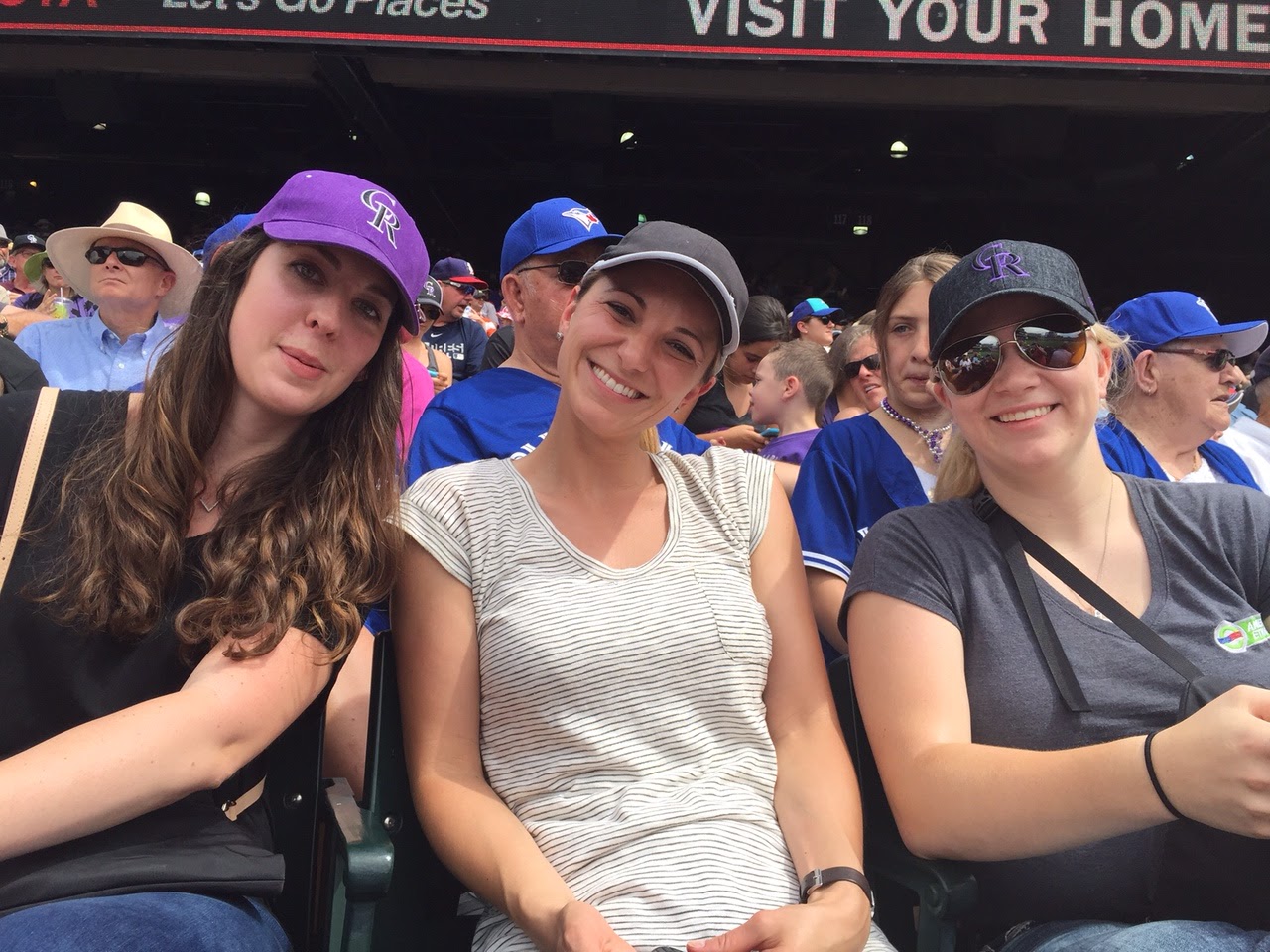
Jessica Strutzel-Trade Analyst, Lindsay Camel-Technical
Services Specialist, and I enjoying the game!
Due to Denver’s hot real estate market, USMEF was informed last fall by building management that they would need to vacate this summer (end of July) or pay the extremely high rent that is being charged in the lower part of downtown, affectionately called LoDo by the locals. The office moved is planned for the end of July, as USMEF was able to negotiate a new lease on the east side of downtown at much more favorable rates. However, because the current office is located within two blocks of Coors Field, USMEF management wanted to host a staff teambuilding get together at a Colorado Rockies game before leaving this area.

And here is evidence of the fun we had at the game (Rockies vs. Blue Jays), I will leave out the score so that we can stay upbeat!

View of the mountains from the bike trail
I was fortunate that my boss, John let me take off a day and a half, so I could join the rest of my family for vacation.  I invited them to come into the office, so they could see where I work, and so I could show off my beautiful niece, Hallie.  After an office visit, we were off to Keystone to celebrate Independence Day Weekend. We enjoyed a gondola ride to the top of the mountain, a 6-mile bike ride with gorgeous views, and watched the rain from inside with a mountain views. 

June 26, 2016

Summer in Denver is off to a Great Start

Share:

By Kelsey Scheer, USMEF summer intern.


John Hinners and me in the USMEF office
After spending the past two summers on my family farm at home, I decided to apply for the U. S. Meat Export Federation (USMEF) Summer Internship through the NebraskaCorn Board. To my surprise, I actually got it! Once May rolled around, I packed up and headed west. Thankfully my parents were able to help me move in to my new summer home in Denver.  Our first day in Denver, John Hinners, Assistant VP of Industry Relations, showed us around the office and introduced us to many of the staff members.

I spent my first two days getting acquainted with the USMEF website, learning about what they do, and helping employees get ready for the Board of Directors Meetings. On what would have been my third and fourth days at the office, I toured Colorado’s beef industry with two Japanese Trade Teams. We visited the JBS Beef Plant in Greeley, JBS Five Rivers Cattle Company, and finished the day riding horses at Sylvan Dale Guest Ranch in Loveland. The final day we toured the Cargill Beef Plant in Fort Morgan and Aristocrat Angus in Platteville. I enjoyed visiting all of these places, because I learned more about each specific industry and I was able to get to know the Japanese teams.
Horse Riding with the
Japan Trade Team at Sylvan Dale Guest Ranch

I took this on the horse riding trip, these are beautiful views
After four days at USMEF, I traveled to St. Louis for the annual Board of Directors Meeting and Product Showcase. About 250 members and 150 international buyers attended the meetings to discuss red meat exports. During the meetings, I was asked to help set up the Foreign Buyers Conference and the Pork Caucus Meeting. I was able to sit in on the Feedgrain and Oilseed Caucus, where they talked about how in 2015, the red meat exports added $0.45 per bushel to the price of corn.  I really enjoyed being able to attend this year’s meetings, because I was able to network with industry leaders, meet USMEF staff from around the world, and assist the USMEF staff.  I was also able to have supper with the Nebraska Corn Board staff, board members, and past USMEF chairman from Nebraska, Mark Jagels.

I am very fortunate to work in an office that is filled with skilled, passionate, and helpful employees. I'm really looking forward to what the rest of the summer has in store for me, and how this experience will be very beneficial for my future in the agricultural industry. 

May 31, 2016

Nebraska Corn 2016 Internships Announced

Share:
Seven Nebraska Students Selected to Represent Nebraska Corn in Internships

(L-R): Morgan Schilling, Laura Lundeen, Lauren Stohlmann,
Kelsey Scheer, Andrea Gurney & Colton Flower (Not Pictured, Maddy Breeling)
The Nebraska Corn Board (NCB) and Nebraska CornGrowers Association (NeCGA) are proud to support seven college students as interns starting this summer. 

Five of the seven interns will be hosted by national cooperators of NCB, including: the National Corn Growers Association in St. Louis, Missouri and Washington, D.C., the U.S. Meat Export Federation in Denver, Colorado and the U.S. Grains Council in Washington, D.C. and internationally in the Panama City, Panama office. The other two internship programs will be yearlong internships in the Nebraska Corn offices in Lincoln.

“We are thrilled to once again be able to offer these various internship opportunities to an excellent group of students,” said Kelly Brunkhorst, executive director for the Nebraska Corn Board. “Nebraskans should be very proud of these bright and energetic collegiate candidates. They represent an insightful next generation of young people who will help bring a new dimension to producing food, feed, fuel and fiber for a growing world population.”

Below is a listing of students who were selected for this year's internships and a short description of what they'll be experiencing. You can keep up with these students and their experiences throughout the summer here on the blog under the "Interns 2016" label.


The National Corn Growers Association headquarters’ office in St. Louis, Missouri, will host Lauren Stohlmann of Murdock, Nebraska, as their summer intern supported by a partnership between NCB and NCGA. Lauren will be a senior in Agricultural and Environmental Sciences Communications at the University of Nebraska-Lincoln. She will be primarily working with market development on the American Ethanol NASCAR sponsorship as well as participating in a variety of other communications and grassroots activities.

The National Corn Growers Association (NCGA) office in Washington, D.C. will host Colton Flower of Scottsbluff, Nebraska, as their summer intern supported by a partnership between NCB and NCGA. Colton will be a senior in Agricultural Education/Leadership with minors in Agribusiness-Entrepreneurship and Animal Science at the University of Nebraska-Lincoln. During his internship, he will be involvedx with a variety of agricultural issues related to environmental regulations, transportation, free trade agreements, biotechnology, ethanol, and energy.


The U.S. Meat Export Federation (USMEF), located in Denver, Colorado will host Kelsey Scheer of St. Paul, Nebraska, as their summer intern supported by a partnership between NCB and USMEF. Kelsey will be a senior in Animal Science with a Production and Management option from the University of Nebraska-Lincoln. She will be assisting with beef, pork and lamb specific projects, as well as promotions and international relationship opportunities.


The U.S. Grains Council (USGC) in Washington, DC will host Maddy Breeling of Omaha, Nebraska, as their summer intern supported by a partnership between NCB and USGC. Maddy will be a senior studying Global Studies, with minors in Business and National Security at the University of Nebraska – Lincoln. She will be working with the global programs team and assisting with preparation for international trade teams and other market development programs that help to develop demand for U.S. coarse grains and co-products.


In cooperation with NCB, the U.S. Grains Council will also host Andrea Gurney from Torrington, Wyoming, as their international intern in the Panama City, Panama office. Andrea will be a senior majoring in Agricultural Business at the University of Nebraska-Lincoln. She will be working with the western hemisphere team on issues related to global trade in food and agricultural products, assisting with communication to importers. 

The NeCGA office in Lincoln is happy to welcome Laura Lundeen of Axtell, Nebraska, for a yearlong internship. Laura will be a junior in Agricultural Education with minors in Animal Science and Agronomy at the University of Nebraska-Lincoln. She will oversee NeCGA’s online communications as well as contribute to a variety of communication and outreach projects.


The NCB office in Lincoln is excited to welcome Morgan Schilling of McCook, Nebraska, for a yearlong internship. Morgan will be a senior studying Agricultural Education with a minor in Agronomy at the University of Nebraska – Lincoln. As part of his internship, he will oversee Nebraska Corn’s crop progress report placement, contribute to communication programs and projects and will help coordinate educational and promotional activities.


“Nebraska Corn’s internship program has been engaging students for over 20 years and has been a great investment into Nebraska’s agricultural future.  As our board has observed, the educational and career advantages these internships have provided to students over the years, have been instrumental in motivating students go on to excel in agricultural focused careers,” added Brunkhorst.

May 5, 2016

USMEF, USFRA, and USGC Discussions at Commodity Classic

Share:
As the current Nebraska Corn Board intern, I was able to attend Commodity Classic 2016 in New Orleans. While there, I spent some time at the trade show, engaging in conversations with several different agribusinesses. I stopped by the following three booths: United States Meat Export Federation (USMEF), United States Farmers and Ranchers Alliance (USFRA), and the United States Grains Council (USGC). I had really great, informative conversations with each of these three agricultural groups.

At the USMEF booth, I learned that their mission is, "to increase the value and profitability of the U.S. beef, pork and lamb industries by enhancing demand for their products in export markets through a dynamic partnership of all stakeholders." This past year they were able to set a new record for global pork exports, which increased by about 5 percent from last year. This was largely driven by demand in China, Mexico and South Korea. After speaking with a representative of USMEF, I was informed that one of their main focuses this year has been producer education, which will continue being a priority into the upcoming years. Being present at Commodity Classic helped USMEF reach these producers from all over the nation.

I also spoke with employees of USFRA. Their main goal is to communicate all aspects of agriculture with consumers who might have questions about how today's food is grown and raised. The vision of USFRA is to build trust and confidence in today's agricultural practices. Specifically, they have been working to build the bridge between farmers and consumers. This year, they have focused on farmers thanking consumers and have trained farmers to be comfortable talking to consumers about any concerns or questions they may have.

Finally, I spoke with representatives of USGC. Their goal at Commodity Classic was to entertain all attendees, but doing so in a way that would show the importance of agricultural trade. Their mission is to develop markets, enable trade, and improve lives. I learned that one of their main priorities is to help people understand the global picture of crops, including prices and profitability. Being present at Commodity Classic allowed USGC to create new partnerships by building valued, long-lasting relationships with farmers, agricultural leaders, policymakers and administrators.

March 24, 2016

Exports Matter to Nebraska Corn Farmers

Share:
International exports play a crucial role in supporting prices and enhancing the value of Nebraska corn!

With more than 95% of the world’s population living outside the United States and representing 75% of the world’s purchasing power, there is huge market potential for Nebraska corn around the world. From raw grain—to red meat—to ethanol, exports in all forms help support corn prices for Nebraska corn farmers. And each value-added product plays a fundamental role in building global demand.

Enhancing the profitability of Nebraska corn and value-added corn products through market development is one of the cornerstones of the Nebraska Corn Board. That’s why the Nebraska Corn Board has long standing relationships with organizations such as the US Grains Council (USGC) and the US Meat Export Federation (USMEF).  With offices in key markets around the world, these organizations work hard to help identify and develop export markets for Nebraska corn. Their international directors are positioned as the ‘boots on the ground’ force that helps recognize opportunity and identify challenges in new and existing global markets.

“Even though most corn grown in Nebraska is used right here in our state for livestock and ethanol—or shipped to dairies in California and feedlots in Texas, we still have a lot at stake when it comes to exports,” said Alan Tiemann, a farmer from Seward, the at-large director on the Nebraska Corn Board and chairman of the U.S. Grains Council. “International exports in all forms help use the U.S. corn supply and create demand that affects our corn prices here at home.”

As the chairman of the USGC, Tiemann has a key role in helping the Council identify new opportunities and priorities in a rapidly changing global market. With the population projected to grow to 9 billion by 2050, USGC is working hard to teach producers around the world how to use feed grains effectively and manage their operations efficiently.

In February, Tiemann helped lead USGC’s 13th annual International Marketing Conference where they highlighted the Council’s mission to drive Excellence in Exports. One key topic of discussion at the conference was ethanol exports. “Ethanol exports continue to be a big priority to the Grains Council. As the number of vehicles increase worldwide, international markets for ethanol are growing dramatically,” added Tiemann.

USGC is the market development arm for Nebraska corn and value-added corn products around the world, while USMEF is the market development arm working to increase our market share for red meat around the world. Both organizations have international directors that work around the globe to build demand, knock down trade barriers and serve our customers in the most critical overseas markets.


To hear more of Tiemann’s remarks on the USGC’s International Marketing Conference, watch our video above.  Additionally, to learn more about the importance of exports to Nebraska corn farmers, watch our video, “Why Exports Matter to Nebraska Corn Farmers.”

February 29, 2016

U.S. cattle on feed down, but red meat exports looking positive

Share:
While the Cattle of Feed report that came out earlier this month showed a decline in cattle on feed for Nebraska and the U.S., there was a positive report on global meat exports from USMEF.

Cattle on Feed Report


Nebraska feedlots, with capacities of 1,000 or more head, contained 2.46 million cattle on feed on February 1, according to the USDA's National Agricultural Statistics Service. This inventory was down 2 percent from last year. Placements during January totaled 490,000 head, down 3 percent from 2015. Fed cattle marketings for the month of January totaled 435,000 head, down 3 percent from last year. Other disappearance during January totaled 15,000 head, unchanged from last year.

Cattle and calves on feed for the slaughter market in the United States for feedlots with capacity of 1,000 or more head totaled 10.7 million head on February 1, 2016. The inventory was slightly below February 1, 2015.

Placements in feedlots during January totaled 1.78 million head, 1 percent below 2015. Net placements were 1.72 million head. During January, placements of cattle and calves weighing less than 600 pounds were 340,000 head, 600-699 pounds were 365,000 head, 700-799 pounds were 494,000 head, and 800 pounds and greater were 580,000 head.

Positive Signs for U.S. Red Meat Emerging Markets 


FAS Regional Counselor Quintin Gray (left) and USDA Undersecretary
Alexis Taylor (right) assist chef Robin Gomes at the Taste of the U.S.A.
culinary demonstration at Gulfood 2016. Photo credit: USMEF
The U.S.Meat Export Federation recently participated in Gulfood 2016 which included a week of face-to-face meetings with potential customers from the Middle East, Africa, Asia and Europe. The region’s largest food show, which attracted about 90,000 people from 170 countries this year, was held in Dubai, United Arab Emirates (UAE).

Dan Halstrom, USMEF senior vice president for global marketing, said the atmosphere at Gulfood was upbeat despite economic challenges in the region created by declining oil prices. He described the show as very productive from the U.S. meat industry’s standpoint.

“The interest level from many countries was exciting,” said Halstrom. “Whether we are talking about the UAE, Jordan, Ghana, or South Africa, it was obvious that with the emerging nature of some of these market economies there is excellent potential for imported beef products.”

South Africa in particular was a hot topic of discussion at Gulfood, Halstrom noted. The market recently reopened to U.S. beef for the first time since 2003, and USMEF is planning in-market visits and a buyers’ event in that part of the world later this year. Just this past Friday, it was announced that South Africa has also reopened to U.S. pork.

February 8, 2016

Exports Highlighted as Key to Cattle Price Recovery

Share:
Thousands of cattle producers from across the nation gathered in San Diego the beginning of this month for the Cattle Industry Annual Convention. With producers enduring a sharp decline in cattle prices in the second half of 2015, many of the event’s presentations centered on factors that can help fuel a price recovery – with a rebound in U.S. beef exports topping the list.

“Even during this difficult time for the industry, producer support for expanding global demand for U.S. beef is steadfast, and that is very gratifying to see,” said U.S. Meat Export Federation (USMEF) President and CEO Philip Seng. “Cattle producers also recognize that the United States is in a period of aggressive herd rebuilding, and this presents tremendous opportunities for industry growth. But we can only capitalize on these opportunities if we are equally aggressive about promoting our product and expanding our international customer base.”

Throughout the week, producers visited the USMEF trade show booth to receive information explaining the importance of beef exports to their bottom lines and how the Beef Checkoff Program supports market development activities in key international destinations.

The Checkoff Export Growth Committee met Friday afternoon to weigh industry priorities related to international marketing and discuss how these activities support the goals of the beef industry’s 2016-2020 long range plan. Seng addressed the committee on key market access issues, including animal traceability. He noted that while traceability was once viewed as a non-tariff trade barrier, that outlook has changed due to the number of competitors that are leveraging traceability systems to their advantage when promoting beef internationally.

Dan Halstrom, USMEF senior vice president for marketing, and Greg Hanes, assistant vice president for international marketing and programs, presented the committee with updates on marketing activities and strategies in key markets, with particular focus on Japan, South Korea and Taiwan. Halstrom also discussed recent efforts to bolster U.S. beef’s presence in Sub-Saharan Africa.

Also addressing the committee was John Masswohl, director of government and international relations for the Canadian Cattlemen’s Association. With U.S. beef producers hoping to regain access to the Chinese market in the near future, Masswohl shared his observations on the opportunities on which Canadian beef has capitalized in China, as well as the obstacles Canada still faces.


Following the meeting, Export Growth Committee members enjoyed samples of Korean dishes prepared with U.S. beef – including LA galbi made with bone-in short rib, bulgogi prepared with top blade and a zucchini and beef dish featuring ground chuck roll.

Just as important as feeding corn and its co-products to livestock is developing markets for Nebraska beef and pork overseas. After all, sending corn-fed beef and pork to international customers around the world has a larger economic impact than exporting raw corn and corn co-products. 

This is why the Nebraska Corn Board became one of the first members of the U.S. Meat Export Federation (USMEF) when USMEF was founded in 1979. Since then, the Board has invested several million dollars into USMEF market promotion activities and supported U.S. beef and pork trade missions around the world.

October 9, 2015

Let's Celebrate October is Pork Month!

Share:
October became known as Pork Month because it marked the time of year when hogs were traditionally marketed. Today, it serves as a celebration to thank pork producers and share their stories with consumers. This is a great time for corn farmers to show appreciation to one of our great customers, too.

Pork is the world’s most widely eaten meat representing 42% of the meat consumed, according to the USDA Foreign Agricultural Service. Some 81% of the population consumes pork in-home at least once in an average two-week period.

The top five most popular pork products include ham, sausage, bacon, lunchmeat (excluding ham) and pork chops. Of pork products consumed at home, ham accounts for 31.1%, sausage represents 19.6%, bacon totals 18.1%, lunchmeat accounts for 10.3% and pork chops round out the top five with 10.2% of pork consumed in-home.

Another way Nebraska corn farmers support pork production is through the U.S. Meat Export Federation, who opens up export markets for U.S. pork and beef.

Here are some interesting, quick pork facts in an infographic - easy to share with your family and friends this month!

August 18, 2015

Greetings from Nebraska!

Share:
By Kaydee Caldwell, US Meat Export Federation Intern

I have been home for a few days; my last day at USMEF was July 31. I had an amazing summer full of experiences that are simply invaluable. These last few months have been unforgettable. To start off my internship I attended the USMEF Board of Directors meeting in San Antonio, TX. The meetings I attended and speakers I was able to listen to made for a very enlightening experience. The first few weeks of my internship were filled with such a gain of knowledge that I can’t wait to apply to my classes at school, as well as my future career.

My big project for the summer was to put together a pork book showcasing the cuts that we export around the world. To start off the project, I emailed all of our international offices to find out which cuts were most popular in the different regions. The next step was to contact a photographer and packing plant and get everything lined up to get pictures of the cuts. 
Travis and I being meat beauticians at the pork photo shoot.

Once we were done with the photo shoot we contacted the graphic designer and had a meeting about the layout and talked about the time frame of the project.  Once we got all the pictures from the photographer, we found plated shots of poplar meals in each region and created a layout of the book to give the graphic designer an idea of how we wanted the pictures laid out. Before I left, we got our first proof back and I couldn’t be more excited about how this book is going to turn out!! I would like to give a quick shout out to Travis, Cheyenne, Lindsey and Paul for being so helpful when it came to this project. Their knowledge was very much appreciated and I truly enjoyed working with them.

Another project I had was to scout out different nations export associations and figure out exactly what we were competing with on a monetary and advertising basis. I looked up numerous annual reports, advertising campaigns and looked through the different members of their associations to figure out exactly what we are up against. Australia is by far one of our biggest competitors in the beef industry and although we have some of the best beef product in the world, they are able to get their product into way more countries. Their budget just for beef export promotion is $136 Million; our budget isn’t near that. I was just truly shocked, a major difference is while we give $1 to our checkoff program here in America, in Australia where their herd is bigger they give $5 a head, and look at the difference!! I gained some serious insight on competitors and had a great time feeling like a detective of red meat! Once I got done researching I printed out some of the information that was more useful and created a binder of our biggest competitors for future use.

There is a lot of transition going on at the office in Denver so I go to spend a few weeks playing receptionist and pretending to be Pam off “The Office”. I had a great time working with the lovely people of the USMEF Denver office and hope to keep in touch with them. I would like to thank John Hinners for doing a great job of keeping an eye on me and making sure I was well taken care of - he was a great boss and I really appreciated everything he did for me. Janel Domurat was another amazing co-worker of mine that I always enjoyed chatting with, she has an amazing sense of humor and I know that if I would have needed a mother figure during my time there she would have been more than able to take care of me! Joni Costa was also spectacular to work with, right away when I started she made sure I knew where everything was in the office, ensured I had quality housing and did a great job of making me feel needed! Paul Clayton and Dan Halstom are the last two that I want to give a shout out to, they are such champs when it comes to me giving them some good of Husker smack talk! They were also able to dish it right back, along with John, trying to convince me of Iowa State’s superiority.

My last two days at the office I was treated to lunch dates and had a wonderful time with everyone! On Thursday John, Paul, Travis and Cheyenne took me to Hop Daddy, it was very delicious. Then Friday for lunch I went out with Janel, Tammy, Joni and Angela. They took me to a lovely Italian restaurant where we had some excellent conversation. They embarrassed and entertained me as much as my mother does when they said, “Oh, let’s take a selfie!” I honestly couldn’t have turned redder. I really did enjoy my time with everyone in the office and look forward to seeing them all again.

Finally, I would like to thank the Nebraska Corn Board to sending me to Denver and giving me the opportunity to meet all these amazing people this summer. I had a wonderful time and gained so much knowledge of the red meat industry, found a new perspective of the beef and pork sector that as a producer I had not been exposed to before, and also for giving me the ability to form connections further in the industry with people who could be vital to my career success. I really did enjoy my time in Denver, but I was very excited to come home!

Thank you to everyone at the US Meat Export Federation for your hospitality, I hope our paths will cross again!


Here are some pictures from my summer! 
Last day of work lunch date with some of the fabulous
 ladies in the office! Angela, Janel, Joni and Tammy.
This was my first summer of enjoying the pool and not getting a farmers tan!
First day home and I HAD to go and visit my old show heifers!
And my first Monday back I enjoyed spending the day in the office I’m used to!


June 10, 2015

Greetings from Denver!

Share:
By Kaydee Caldwell, US Meat Export Federation Intern

My name is Kaydee Caldwell; I’m a 5th generation cattle producer and avid beef eater. I’m going into my junior year at the University of Nebraska – Lincoln with a major in Animal Science. This summer I am spending my time in Denver, CO at the U.S. Meat Export Federation through a partnership with the Nebraska Corn Board. Being a producer I have been trying to gain knowledge on what happens after my cattle leave our pastures and enter the feed yards to be finished out. Where does the end product go? Of course the grocery stores, but OUR beef is sent all around the world, and people LOVE it! I’m so thankful for the opportunity to be working with the Meat Export Federation so I can fully grasp the trade concepts as well as what I, as a producer, can do to make our exports even stronger and more sought after.

 I moved to Denver the 11th of May and started working on the 12th. I take the Denver Light Rail to and from work every day, which is pretty handy! It really hasn’t been too hard adjusting to getting through the city; the hardest part is not being able to see pastures of cattle or cornfields! 

I’ve had a few adventures since starting. My second week at work USMEF flew me down to San Antonio, TX for their Board of Directors meeting. I got to walk along the River Walk, eat at NAO, dine at Texas Land & Cattle AND find out what happens when your car keys get lost in a different state! It was a great week listening to numerous industry leaders and having great discussions with members of the international offices. I had a great chat about Beta Agonists with a representative from the EU.

My project for the summer while at USMEF is to compile a pork cuts book that targets the international markets. I’ve contacted our international offices, lined up a photo shoot with a packing plant and photographer and will be going to Guymon, OK next week to get the photos done for the book!

The staff here in Denver is amazing, there’s quite
a few in the office that have really helped me to adjust to living in Denver and helped me through some stressful times, mostly losing my keys in San Antonio. I am truly thankful for the experience and having the opportunity to work with some VERY amazing people. I can’t wait to see what I learn throughout the summer, there’s a lot of knowledge in this office and I plan on absorbing as much of their wisdom as I can.

Now for some fun pictures!
This is my office farm, I have a cow, pig, chicken, steer and owl. 
I have taken up indoor sky diving and it is VERY fun, scary, but fun. 
I was also very excited to find out there is such a thing as a S’mores frappucino!