Showing posts with label animal welfare. Show all posts

February 1, 2016

Animal Advocacy: Articulating Your Story

Share:
Today’s livestock producers take what they do very seriously. The legacy and knowledge of raising animals merits a great pride in farmers and ranchers. They are deeply rooted in their values whether that be in their community, the environment or raising a calf crop each year. With the rearing of animals for meat comes the charge to compassionately care for that animal, become accountable for how they provide for their livestock and positively promote what and why they do what they do.

Animal Welfare


Much of the pride that livestock producers have from raising animals comes from responsibility. Today more than ever, cattle ranchers, pork producers, dairy farmers and poultry producers take the responsibility of raising healthy cattle for high-quality, nutritious beef very genuinely. Much of that responsibility is stewardship which leads to following animal welfare guidelines.

Much of the way livestock and poultry are handled is traditionally passed down from generation to generation on family operations, or comes from personal experience and training. Yet, as industry standards change, producers also want to change to make sure they are doing the best to take care of their animals. Practices of production such as de-horning, castration, use of vaccines and antibiotics, etc., all have their purpose in the industry, but the way they are handled can be skewed by the public eye.

Accountability


Farmers and ranchers must be responsible for the way they handle their animals. One form of accountability for beef producers is the Beef Quality Assurance (BQA) program, a national program that provides guidelines for beef cattle production. This is not new to the industry; cattlemen and women have been practicing stewardship and proper handling for years.

The cattle industry formalized its first quality program in the late 1970s when it was called the “Beef Safety Assurance” program, designed to help cattle farmers and ranchers ensure their production practices were safe and met consumer expectations. The BQA program, the first of its kind in the world, soon followed and was officially established in 1987.

BQA raises consumer confidence through offering proper management techniques and a commitment to quality within every segment of the beef industry. Cattlemen and women have embraced BQA because it is the right thing to do. It is an educating program that has evolved to include best practices around good record keeping and protecting herd health. The pork industry offers similar programs, including Pork Quality Assurance Plus (PQA Plus) and Transport Quality Assurance (TQA), to support animal well-being and maintain a safe, high-quality supply of pork. Their “We Care” initiative ties everything together to help the public view the pork industry as a self-regulated business that earns the trust of others.

The poultry and dairy industries provide similar quality assurance programs, as well.

Advocacy


Along with programs like BQA and PQA Plus, cattle producers are encouraged to practice advocacy techniques while they are in the public eye. Unfortunately, those that do not understand agriculture have misguided ideas and sometimes share erroneous information, pictures and video about the treatment of food animals. In our country, rural communities have declined and consumers are generally two or more generations removed from having meaningful ties with the people and places where their food is raised. Without those ties to agriculture, consumers don’t know about modern food production. And some might not care. Until a video or picture comes across their Facebook news feed and suddenly they are brought into a social license dilemma.

Social media has drastically changed how agriculture is viewed and how people talk about their food. While it has brought negative views and questions to livestock production, the two-way street allows livestock producers to have a voice as well as a listening audience that is focused on where they intersect and can relate with one another. And that intersection is something we all enjoy: food.

When consumers are concerned about how their food is raised, it gives producers an opportunity to talk about their animal welfare and is a good wake-up call to all livestock producers that others are watching. This is especially true at livestock shows. There is a critical eye watching every move and producers need to be ready to share their story with emphasis on why and how.


Articulate Your Story


Are you prepared to answer critical questions on production practices that come naturally to you? Why do you use clippers on your animal? What are you feeding them? Where do you keep your animals? These questions might be something you’ve never thought about. Our industry needs to take time to stand in our consumers’ shoes and have a good working knowledge of the industry, as well as use terminology that most people will understand.

It’s an especially good reminder to be proactive. Help consumers connect the dots by reaching out to them and asking if they have any questions.

December 14, 2015

Do you want to build a snowman? Game Day Chili recipe.

Share:
By Joan Ruskamp, CommonGround volunteer 

We recently got hit by the fourth snow event in two weeks and I just had to take advantage of the wet snow by building a snowman.    I don’t remember the last time I made a snowman because when it snows here my time is spent moving the snow out of the way.    My husband is especially sensitive to songs like “I’m Dreaming of a White Christmas”  and “Let it snow” because snow means more work. 

When we get a snow event there are several jobs that have to be done.  First the roads must be cleared so that the feedtruck and vehicles can get around.   The next job is getting the bunks clean.  We have a very nice piece of equipment that makes this job much easier than when we had to scoop them all with a shovel.  The bunk blower works well unless you get really wet snow.  Really wet snow usually melts or it has to be scooped.

After the cattle are fed and cared for we get to work removing the snow or piling the snow that is in their pens.   The snow eventually gets hauled out so that the pens can stay dry.  When we get wet snow we keep the cement areas cleaned off and put some type of bedding material down so they have a dry place to lie down.

I have always been amazed at how quickly cattle adjust to weather changes.  They seem to adjust the quickest to cold weather.  Cattle are often seen running around in the snow, kicking up their heels and playing like children.   My favorite sight to see is when they are laying down soaking up the warm sun on a cold day.

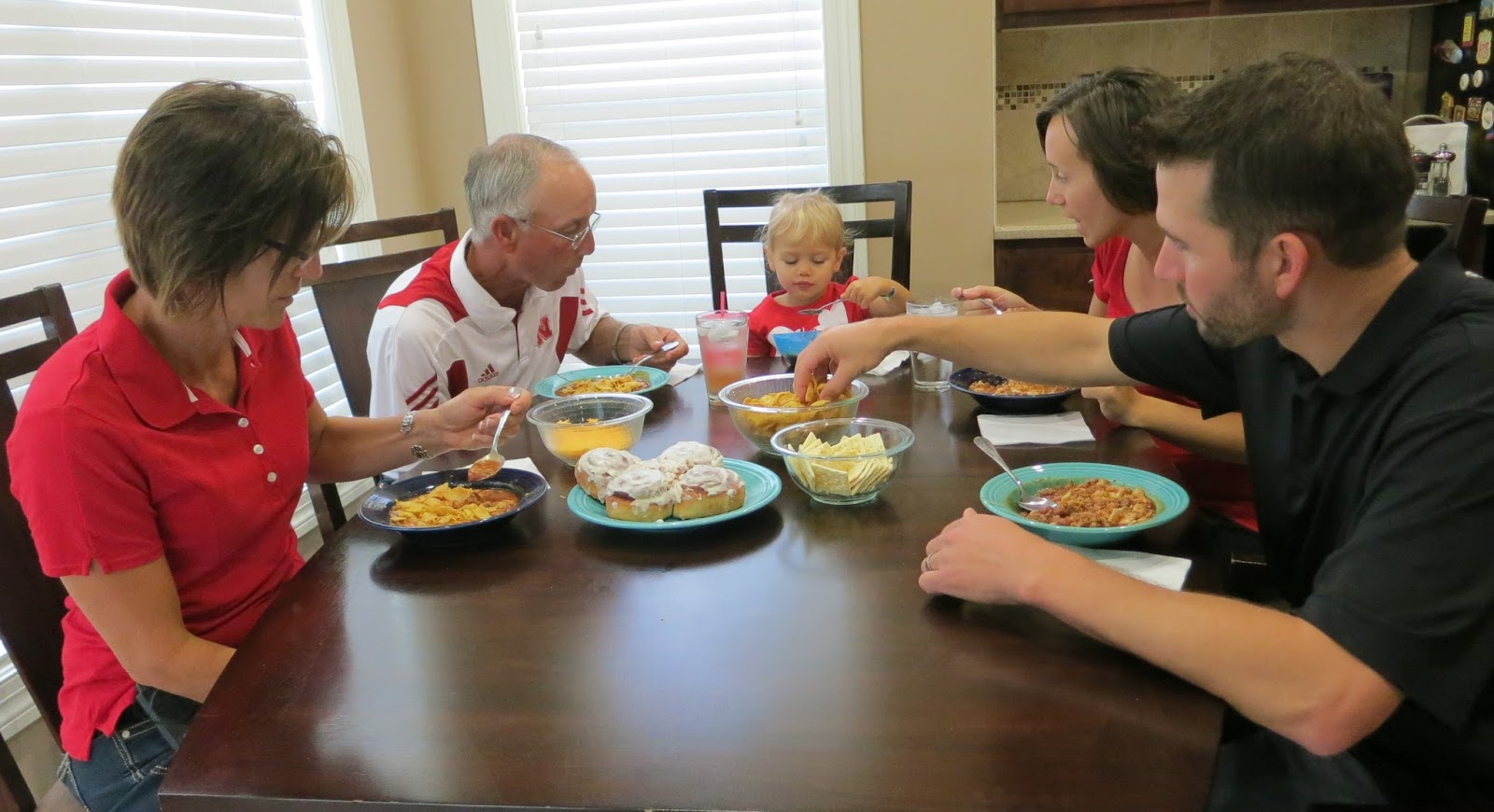
One of our favorite meals to enjoy on a cold day is chili soup.  I have a recipe that has gone over very well with our family and when used at large gatherings.  Here is my recipe: 

chili supper pic

Game Day Chili 

2-pounds ground beef
1-46 ounce can tomato juice
1-27 ounce can Bush’s Chili Beans
1-tablespoon chili powder
1-tablespoon onion flakes

Brown the ground beef with onion flakes. Turn crock pot on high and pour in tomato juice and beans.  Drain hamburger and add to crock pot. Sprinkle chili powder on top and stir mixture.  Leave on high for 1 hour or low for several hours. Toppings that go well are shredded cheddar cheese with crackers or corn chips.  It is a tradition in our community to serve cinnamon rolls with chili soup.